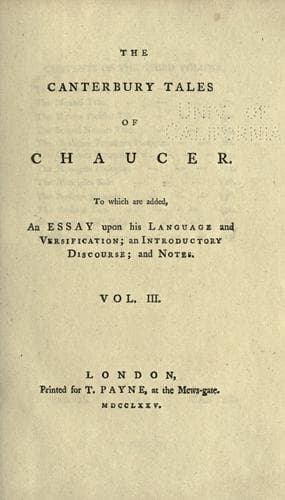
The Canterbury Tales, and Other PoemsChaucer, Geoffrey
ReligionChristian
The Canterbury Tales, and Other Poems
Chaucer, Geoffrey
Chaucer, Geoffrey, -1400; Christian pilgrims and pilgrimages -- Poetry; English poetry -- Middle English, 1100-1500
And saidde, “Thief, thus much am I awreak.* *avenged
Now will I die, I may no longer speak.”
But at the last, with muche care and woe
We fell accorded* by ourselves two: *agreed
He gave me all the bridle in mine hand
To have the governance of house and land,
And of his tongue, and of his hand also.
I made him burn his book anon right tho.* *then
And when that I had gotten unto me
By mast’ry all the sovereignety,
And that he said, “Mine owen true wife,
Do *as thee list,* the term of all thy life, *as pleases thee*
Keep thine honour, and eke keep mine estate;
After that day we never had debate.
God help me so, I was to him as kind
As any wife from Denmark unto Ind,
And also true, and so was he to me:
I pray to God that sits in majesty
So bless his soule, for his mercy dear.
Now will I say my tale, if ye will hear. —
The Friar laugh’d when he had heard all this:
“Now, Dame,” quoth he, “so have I joy and bliss,
This is a long preamble of a tale.”
And when the Sompnour heard the Friar gale,* *speak
“Lo,” quoth this Sompnour, “Godde’s armes two,
A friar will intermete* him evermo’: *interpose <33>
Lo, goode men, a fly and eke a frere
Will fall in ev’ry dish and eke mattere.
What speak’st thou of perambulation?* *preamble
What? amble or trot; or peace, or go sit down:
Thou lettest* our disport in this mattere.” *hinderesst
“Yea, wilt thou so, Sir Sompnour?” quoth the Frere;
“Now by my faith I shall, ere that I go,
Tell of a Sompnour such a tale or two,
That all the folk shall laughen in this place.”
“Now do, else, Friar, I beshrew* thy face,” *curse
Quoth this Sompnour; “and I beshrewe me,
But if* I telle tales two or three *unless
Of friars, ere I come to Sittingbourne,
That I shall make thine hearte for to mourn:
For well I wot thy patience is gone.”
Our Hoste cried, “Peace, and that anon;”
And saide, “Let the woman tell her tale.
Ye fare* as folk that drunken be of ale. *behave
Do, Dame, tell forth your tale, and that is best.”
“All ready, sir,” quoth she, “right as you lest,* *please
If I have licence of this worthy Frere.”
“Yes, Dame,” quoth he, “tell forth, and I will hear.”
Notes to the Prologue to the Wife of Bath’s Tale
Public-domain text, read in full here on John Shaqi.
Reviews
Reviews
No reviews yet
Be the first to share your thoughts on this work.
Elsewhere in the archive
Join the Discussion
Join the discussion
Sign in to leave a comment or review.
Sign InorCreate an account