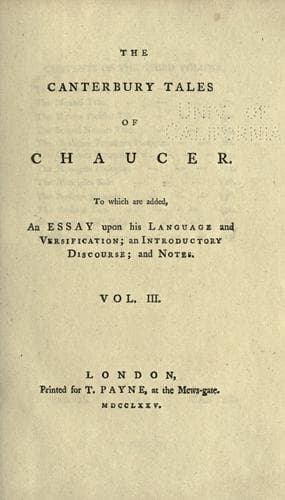
The Canterbury Tales, and Other PoemsChaucer, Geoffrey
ReligionChristian
The Canterbury Tales, and Other Poems
Chaucer, Geoffrey
Chaucer, Geoffrey, -1400; Christian pilgrims and pilgrimages -- Poetry; English poetry -- Middle English, 1100-1500
1. Among the evidences that Chaucer’s great work was left
incomplete, is the absence of any link of connexion between the
Wife of Bath’s Prologue and Tale, and what goes before. This
deficiency has in some editions caused the Squire’s and the
Merchant’s Tales to be interposed between those of the Man of
Law and the Wife of Bath; but in the Merchant’s Tale there is
internal proof that it was told after the jolly Dame’s. Several
manuscripts contain verses designed to serve as a connexion;
but they are evidently not Chaucer’s, and it is unnecessary to
give them here. Of this Prologue, which may fairly be regarded
as a distinct autobiographical tale, Tyrwhitt says: “The
extraordinary length of it, as well as the vein of pleasantry that
runs through it, is very suitable to the character of the speaker.
The greatest part must have been of Chaucer’s own invention,
though one may plainly see that he had been reading the popular
invectives against marriage and women in general; such as the
‘Roman de la Rose,’ ‘Valerius ad Rufinum, De non Ducenda
Uxore,’ (‘Valerius to Rufinus, on not being ruled by one’s wife’)
and particularly ‘Hieronymus contra Jovinianum.’ (‘Jerome
against Jovinianus’) St Jerome, among other things designed to
discourage marriage, has inserted in his treatise a long passage
from ‘Liber Aureolus Theophrasti de Nuptiis.’ (‘Theophrastus’s
Golden Book of Marriage’).”
2. A great part of the marriage service used to be performed in
the church-porch.
3. Jesus and the Samaritan woman: John iv. 13.
4. Dan: Lord; Latin, “dominus.” Another reading is “the wise
man, King Solomon.”
5. Defended: forbade; French, “defendre,” to prohibit.
6. Dart: the goal; a spear or dart was set up to mark the point of
victory.
7. “But in a great house there are not only vessels of gold and
silver, but also of wood and of earth; and some to honour, and
some to dishonour.” — 2 Tim. ii 20.
8. Jesus feeding the multitude with barley bread: Mark vi. 41,
42.
9. At Dunmow prevailed the custom of giving, amid much
merry making, a flitch of bacon to the married pair who had
lived together for a year without quarrel or regret. The same
custom prevailed of old in Bretagne.
10. “Cagnard,” or “Caignard,” a French term of reproach,
originally derived from “canis,” a dog.
11. Parage: birth, kindred; from Latin, “pario,” I beget.
12. Norice: nurse; French, “nourrice.”
13. This and the previous quotation from Ptolemy are due to
the Dame’s own fancy.
14. (Transcriber’s note: Some Victorian censorship here. The
word given in [brackets] should be “queint” i.e. “cunt”.)
15. Women should not adorn themselves: see I Tim. ii. 9.
16. Cherte: affection; from French, “cher,” dear.
17. Nicety: folly; French, “niaiserie.”
18. Ba: kiss; from French, “baiser.”
19. Peter!: by Saint Peter! a common adjuration, like Marie!
from the Virgin’s name.
20. St. Joce: or Judocus, a saint of Ponthieu, in France.
Public-domain text, read in full here on John Shaqi.
Reviews
Reviews
No reviews yet
Be the first to share your thoughts on this work.
Elsewhere in the archive
Join the Discussion
Join the discussion
Sign in to leave a comment or review.
Sign InorCreate an account