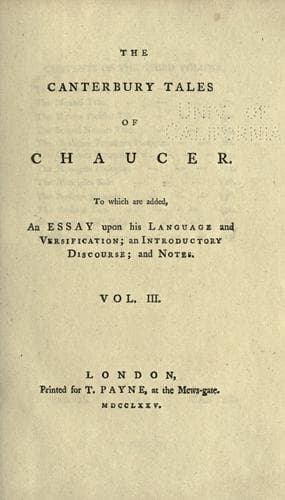
The Canterbury Tales, and Other PoemsChaucer, Geoffrey
ReligionChristian
The Canterbury Tales, and Other Poems
Chaucer, Geoffrey
Chaucer, Geoffrey, -1400; Christian pilgrims and pilgrimages -- Poetry; English poetry -- Middle English, 1100-1500
Here may ye see, though we a time abide,
Yet out it must, we can no counsel hide.
The remnant of the tale, if ye will hear,
Read in Ovid, and there ye may it lear.* *learn
This knight, of whom my tale is specially,
When that he saw he might not come thereby,
That is to say, what women love the most,
Within his breast full sorrowful was his ghost.* *spirit
But home he went, for he might not sojourn,
The day was come, that homeward he must turn.
And in his way it happen’d him to ride,
In all his care,* under a forest side, *trouble, anxiety
Where as he saw upon a dance go
Of ladies four-and-twenty, and yet mo’,
Toward this ilke* dance he drew full yern,** *same **eagerly <10>
The hope that he some wisdom there should learn;
But certainly, ere he came fully there,
Y-vanish’d was this dance, he knew not where;
No creature saw he that bare life,
Save on the green he sitting saw a wife,
A fouler wight there may no man devise.* *imagine, tell
Against* this knight this old wife gan to rise, *to meet
And said, “Sir Knight, hereforth* lieth no way. *from here
Tell me what ye are seeking, by your fay.
Paraventure it may the better be:
These olde folk know muche thing.” quoth she.
My leve* mother,” quoth this knight, “certain, *dear
I am but dead, but if* that I can sayn *unless
What thing it is that women most desire:
Could ye me wiss,* I would well *quite your hire.”* *instruct <11>
“Plight me thy troth here in mine hand,” quoth she, *reward you*
“The nexte thing that I require of thee
Thou shalt it do, if it be in thy might,
And I will tell it thee ere it be night.”
“Have here my trothe,” quoth the knight; “I grant.”
“Thenne,” quoth she, “I dare me well avaunt,* *boast, affirm
Thy life is safe, for I will stand thereby,
Upon my life the queen will say as I:
Let see, which is the proudest of them all,
That wears either a kerchief or a caul,
That dare say nay to that I shall you teach.
Let us go forth withoute longer speech
Then *rowned she a pistel* in his ear, *she whispered a secret*
And bade him to be glad, and have no fear.
Public-domain text, read in full here on John Shaqi.
Reviews
Reviews
No reviews yet
Be the first to share your thoughts on this work.
Elsewhere in the archive
Join the Discussion
Join the discussion
Sign in to leave a comment or review.
Sign InorCreate an account