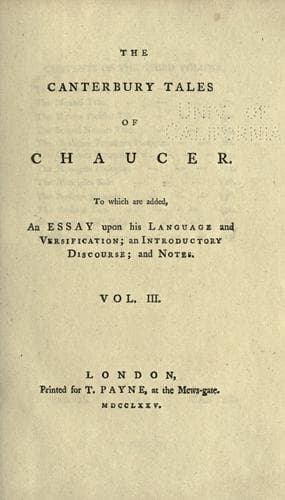
The Canterbury Tales, and Other PoemsChaucer, Geoffrey
ReligionChristian
The Canterbury Tales, and Other Poems
Chaucer, Geoffrey
Chaucer, Geoffrey, -1400; Christian pilgrims and pilgrimages -- Poetry; English poetry -- Middle English, 1100-1500
Now woulde some men say paraventure
That for my negligence I do no cure* *take no pains
To tell you all the joy and all th’ array
That at the feast was made that ilke* day. *same
To which thing shortly answeren I shall:
I say there was no joy nor feast at all,
There was but heaviness and muche sorrow:
For privily he wed her on the morrow;
And all day after hid him as an owl,
So woe was him, his wife look’d so foul
Great was the woe the knight had in his thought
When he was with his wife to bed y-brought;
He wallow’d, and he turned to and fro.
This olde wife lay smiling evermo’,
And said, “Dear husband, benedicite,
Fares every knight thus with his wife as ye?
Is this the law of king Arthoures house?
Is every knight of his thus dangerous?* *fastidious, niggardly
I am your owen love, and eke your wife
I am she, which that saved hath your life
And certes yet did I you ne’er unright.
Why fare ye thus with me this firste night?
Ye fare like a man had lost his wit.
What is my guilt? for God’s love tell me it,
And it shall be amended, if I may.”
“Amended!” quoth this knight; “alas, nay, nay,
It will not be amended, never mo’;
Thou art so loathly, and so old also,
And thereto* comest of so low a kind, *in addition
That little wonder though I wallow and wind;* *writhe, turn about
So woulde God, mine hearte woulde brest!”* *burst
“Is this,” quoth she, “the cause of your unrest?”
“Yea, certainly,” quoth he; “no wonder is.”
“Now, Sir,” quoth she, “I could amend all this,
If that me list, ere it were dayes three,
*So well ye mighte bear you unto me.* *if you could conduct
But, for ye speaken of such gentleness yourself well
As is descended out of old richess, towards me*
That therefore shalle ye be gentlemen;
Such arrogancy is *not worth a hen.* *worth nothing
Look who that is most virtuous alway,
*Prive and apert,* and most intendeth aye *in private and public*
To do the gentle deedes that he can;
And take him for the greatest gentleman.
Christ will,* we claim of him our gentleness, *wills, requires
Not of our elders* for their old richess. *ancestors
For though they gave us all their heritage,
For which we claim to be of high parage,* *birth, descent
Yet may they not bequeathe, for no thing,
To none of us, their virtuous living
That made them gentlemen called to be,
And bade us follow them in such degree.
Well can the wise poet of Florence,
That highte Dante, speak of this sentence:* *sentiment
Lo, in such manner* rhyme is Dante’s tale. *kind of
‘Full seld’* upriseth by his branches smale *seldom
Prowess of man, for God of his goodness
Wills that we claim of him our gentleness;’ <12>
For of our elders may we nothing claim
Public-domain text, read in full here on John Shaqi.
Reviews
Reviews
No reviews yet
Be the first to share your thoughts on this work.
Elsewhere in the archive
Join the Discussion
Join the discussion
Sign in to leave a comment or review.
Sign InorCreate an account