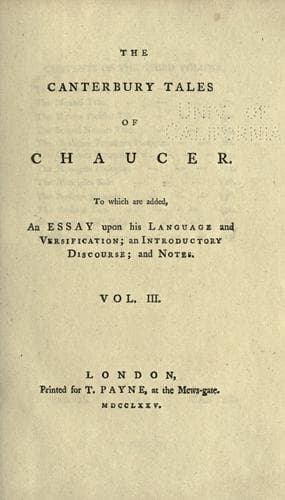
The Canterbury Tales, and Other PoemsChaucer, Geoffrey
ReligionChristian
The Canterbury Tales, and Other Poems
Chaucer, Geoffrey
Chaucer, Geoffrey, -1400; Christian pilgrims and pilgrimages -- Poetry; English poetry -- Middle English, 1100-1500
This knight adviseth* him and sore he siketh,** *considered **sighed
But at the last he said in this mannere;
“My lady and my love, and wife so dear,
I put me in your wise governance,
Choose for yourself which may be most pleasance
And most honour to you and me also;
I *do no force* the whether of the two: *care not
For as you liketh, it sufficeth me.”
“Then have I got the mastery,” quoth she,
“Since I may choose and govern as me lest.”* *pleases
“Yea, certes wife,” quoth he, “I hold it best.”
“Kiss me,” quoth she, “we are no longer wroth,* *at variance
For by my troth I will be to you both;
This is to say, yea, bothe fair and good.
I pray to God that I may *sterve wood,* *die mad*
But* I to you be all so good and true, *unless
As ever was wife since the world was new;
And but* I be to-morrow as fair to seen, *unless
As any lady, emperess or queen,
That is betwixt the East and eke the West
Do with my life and death right as you lest.* *please
Cast up the curtain, and look how it is.”
And when the knight saw verily all this,
That she so fair was, and so young thereto,
For joy he hent* her in his armes two: *took
His hearte bathed in a bath of bliss,
A thousand times *on row* he gan her kiss: *in succession*
And she obeyed him in every thing
That mighte do him pleasance or liking.
And thus they live unto their lives’ end
In perfect joy; and Jesus Christ us send
Husbandes meek and young, and fresh in bed,
And grace to overlive them that we wed.
And eke I pray Jesus to short their lives,
That will not be governed by their wives.
And old and angry niggards of dispence,* *expense
God send them soon a very pestilence!
Notes to the Wife of Bath’s Tale
1. It is not clear whence Chaucer derived this tale. Tyrwhitt
thinks it was taken from the story of Florent, in the first book of
Gower’s “Confessio Amantis;” or perhaps from an older
narrative from which Gower himself borrowed. Chaucer has
condensed and otherwise improved the fable, especially by
laying the scene, not in Sicily, but at the court of our own King
Arthur.
2. Limitours: begging friars. See note 18 to the prologue to the
Tales.
3. Thorpes: villages. Compare German, “Dorf,”; Dutch,
“Dorp.”
4. Undermeles: evening-tides, afternoons; “undern” signifies the
evening; and “mele,” corresponds to the German “Mal” or
“Mahl,” time.
5. Incubus: an evil spirit supposed to do violence to women; a
nightmare.
6. Where he had been hawking after waterfowl. Froissart says
that any one engaged in this sport “alloit en riviere.”
7. Nice: foolish; French, “niais.”
8. Claw us on the gall: Scratch us on the sore place. Compare,
“Let the galled jade wince.” Hamlet iii. 2.
9. Hele: hide; from Anglo-Saxon, “helan,” to hide, conceal.
10. Yern: eagerly; German, “gern.”
Public-domain text, read in full here on John Shaqi.
Reviews
Reviews
No reviews yet
Be the first to share your thoughts on this work.
Elsewhere in the archive
Join the Discussion
Join the discussion
Sign in to leave a comment or review.
Sign InorCreate an account