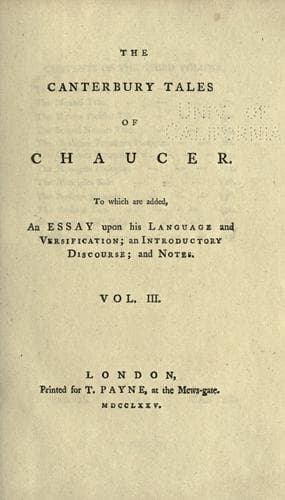
The Canterbury Tales, and Other PoemsChaucer, Geoffrey
ReligionChristian
The Canterbury Tales, and Other Poems
Chaucer, Geoffrey
Chaucer, Geoffrey, -1400; Christian pilgrims and pilgrimages -- Poetry; English poetry -- Middle English, 1100-1500
11. Wiss: instruct; German, “weisen,” to show or counsel.
12. Dante, “Purgatorio”, vii. 121.
13. “Cantabit vacuus coram latrone viator” — “Satires,” x. 22.
14. In a fabulous conference between the Emperor Adrian and
the philosopher Secundus, reported by Vincent of Beauvais,
occurs the passage which Chaucer here paraphrases: — “Quid
est Paupertas? Odibile bonum; sanitas mater; remotio Curarum;
sapientae repertrix; negotium sine damno; possessio absque
calumnia; sine sollicitudinae felicitas.” (What is Poverty? A
hateful good; a mother of health; a putting away of cares; a
discoverer of wisdom; business without injury; ownership
without calumny; happiness without anxiety)
15. Elenge: strange; from French “eloigner,” to remove.
THE FRIAR’S TALE.
THE PROLOGUE.<1>
This worthy limitour, this noble Frere,
He made always a manner louring cheer* *countenance
Upon the Sompnour; but for honesty* *courtesy
No villain word as yet to him spake he:
But at the last he said unto the Wife:
“Dame,” quoth he, “God give you right good life,
Ye have here touched, all so may I the,* *thrive
In school matter a greate difficulty.
Ye have said muche thing right well, I say;
But, Dame, here as we ride by the way,
Us needeth not but for to speak of game,
And leave authorities, in Godde’s name,
To preaching, and to school eke of clergy.
But if it like unto this company,
I will you of a Sompnour tell a game;
Pardie, ye may well knowe by the name,
That of a Sompnour may no good be said;
I pray that none of you be *evil paid;* *dissatisfied*
A Sompnour is a runner up and down
With mandements* for fornicatioun, *mandates, summonses*
And is y-beat at every towne’s end.”
Then spake our Host; “Ah, sir, ye should be hend* *civil, gentle
And courteous, as a man of your estate;
In company we will have no debate:
Tell us your tale, and let the Sompnour be.”
“Nay,” quoth the Sompnour, “let him say by me
What so him list; when it comes to my lot,
By God, I shall him quiten* every groat! *pay him off
I shall him telle what a great honour
It is to be a flattering limitour
And his office I shall him tell y-wis”.
Our Host answered, “Peace, no more of this.”
And afterward he said unto the frere,
“Tell forth your tale, mine owen master dear.”
Notes to the Prologue to the Friar’s tale
Public-domain text, read in full here on John Shaqi.
Reviews
Reviews
No reviews yet
Be the first to share your thoughts on this work.
Elsewhere in the archive
Join the Discussion
Join the discussion
Sign in to leave a comment or review.
Sign InorCreate an account