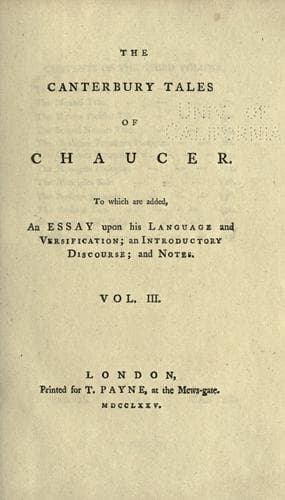
The Canterbury Tales, and Other PoemsChaucer, Geoffrey
ReligionChristian
The Canterbury Tales, and Other Poems
Chaucer, Geoffrey
Chaucer, Geoffrey, -1400; Christian pilgrims and pilgrimages -- Poetry; English poetry -- Middle English, 1100-1500
1. On the Tale of the Friar, and that of the Sompnour which
follows, Tyrwhitt has remarked that they “are well engrafted
upon that of the Wife of Bath. The ill-humour which shows
itself between these two characters is quite natural, as no two
professions at that time were at more constant variance. The
regular clergy, and particularly the mendicant friars, affected a
total exemption from all ecclesiastical jurisdiction, except that
of the Pope, which made them exceedingly obnoxious to the
bishops and of course to all the inferior officers of the national
hierarchy.” Both tales, whatever their origin, are bitter satires
on the greed and worldliness of the Romish clergy.
THE TALE.
Whilom* there was dwelling in my country *once on a time
An archdeacon, a man of high degree,
That boldely did execution,
In punishing of fornication,
Of witchecraft, and eke of bawdery,
Of defamation, and adultery,
Of churche-reeves,* and of testaments, *churchwardens
Of contracts, and of lack of sacraments,
And eke of many another manner* crime, *sort of
Which needeth not rehearsen at this time,
Of usury, and simony also;
But, certes, lechours did he greatest woe;
They shoulde singen, if that they were hent;* *caught
And smale tithers<1> were foul y-shent,* *troubled, put to shame
If any person would on them complain;
There might astert them no pecunial pain.<2>
For smalle tithes, and small offering,
He made the people piteously to sing;
For ere the bishop caught them with his crook,
They weren in the archedeacon’s book;
Then had he, through his jurisdiction,
Power to do on them correction.
He had a Sompnour ready to his hand,
A slier boy was none in Engleland;
For subtlely he had his espiaille,* *espionage
That taught him well where it might aught avail.
He coulde spare of lechours one or two,
To teache him to four and twenty mo’.
For, — though this Sompnour wood* be as a hare, — *furious, mad
To tell his harlotry I will not spare,
For we be out of their correction,
They have of us no jurisdiction,
Ne never shall have, term of all their lives.
“Peter; so be the women of the stives,”* *stews
Quoth this Sompnour, “y-put out of our cure.”* *care
“Peace, with mischance and with misaventure,”
Our Hoste said, “and let him tell his tale.
Now telle forth, and let the Sompnour gale,* *whistle; bawl
Nor spare not, mine owen master dear.”
Public-domain text, read in full here on John Shaqi.
Reviews
Reviews
No reviews yet
Be the first to share your thoughts on this work.
Elsewhere in the archive
Join the Discussion
Join the discussion
Sign in to leave a comment or review.
Sign InorCreate an account