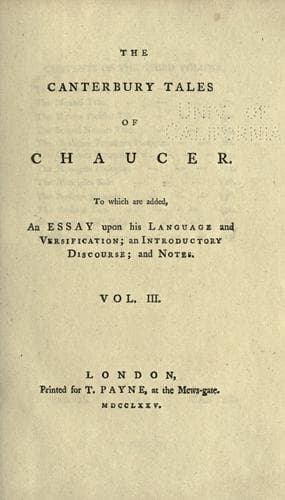
The Canterbury Tales, and Other PoemsChaucer, Geoffrey
ReligionChristian
The Canterbury Tales, and Other Poems
Chaucer, Geoffrey
Chaucer, Geoffrey, -1400; Christian pilgrims and pilgrimages -- Poetry; English poetry -- Middle English, 1100-1500
3. In Chaucer’s day the most material notions about the tortures
of hell prevailed, and were made the most of by the clergy, who
preyed on the affection and fear of the survivors, through the
ingenious doctrine of purgatory. Old paintings and illuminations
represent the dead as torn by hooks, roasted in fires, boiled in
pots, and subjected to many other physical torments.
4. Qui cum patre: “Who with the father”; the closing words of
the final benediction pronounced at Mass.
5. Askaunce: The word now means sideways or asquint; here it
means “as if;” and its force is probably to suggest that the
second friar, with an ostentatious stealthiness, noted down the
names of the liberal, to make them believe that they would be
remembered in the holy beggars’ orisons.
6. A Godde’s kichel/halfpenny: a little cake/halfpenny, given for
God’s sake.
7. Harlot: hired servant; from Anglo-Saxon, “hyran,” to hire;
the word was commonly applied to males.
8. Potent: staff; French, “potence,” crutch, gibbet.
9. Je vous dis sans doute: French; “I tell you without doubt.”
10. Dortour: dormitory; French, “dortoir.”
12. The Rules of St Benedict granted peculiar honours and
immunities to monks who had lived fifty years — the jubilee
period — in the order. The usual reading of the words ending
the two lines is “loan” or “lone,” and “alone;” but to walk alone
does not seem to have been any peculiar privilege of a friar,
while the idea of precedence, or higher place at table and in
processions, is suggested by the reading in the text.
13. Borel folk: laymen, people who are not learned; “borel”
was a kind of coarse cloth.
14. Eli: Elijah (1 Kings, xix.)
15. An emperor Jovinian was famous in the mediaeval legends
for his pride and luxury
16. Cor meum eructavit: literally, “My heart has belched forth;”
in our translation, (i.e. the Authorised “King James” Version -
Transcriber) “My heart is inditing a goodly matter.” (Ps. xlv.
1.). “Buf” is meant to represent the sound of an eructation, and
to show the “great reverence” with which “those in possession,”
the monks of the rich monasteries, performed divine service,
17. N’ere thou our brother, shouldest thou not thrive: if thou
wert not of our brotherhood, thou shouldst have no hope of
recovery.
18. Thomas’ life of Ind: The life of Thomas of India - i.e. St.
Thomas the Apostle, who was said to have travelled to India.
19. Potestate: chief magistrate or judge; Latin, “potestas;”
Italian, “podesta.” Seneca relates the story of Cornelius Piso;
“De Ira,” i. 16.
20. Placebo: An anthem of the Roman Church, from Psalm
cxvi. 9, which in the Vulgate reads, “Placebo Domino in regione
vivorum” — “I will please the Lord in the land of the living”
21. The Gysen: Seneca calls it the Gyndes; Sir John Mandeville
tells the story of the Euphrates. “Gihon,” was the name of one
of the four rivers of Eden (Gen. ii, 13).
22. Him that harrowed Hell: Christ. See note 14 to the Reeve’s
Tale.
Public-domain text, read in full here on John Shaqi.
Reviews
Reviews
No reviews yet
Be the first to share your thoughts on this work.
Elsewhere in the archive
Join the Discussion
Join the discussion
Sign in to leave a comment or review.
Sign InorCreate an account