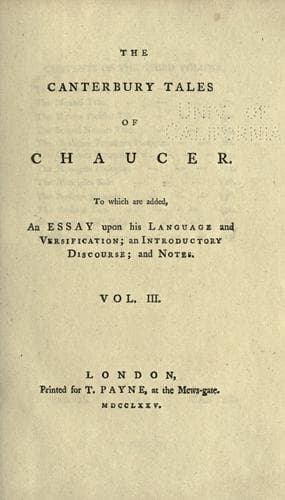
The Canterbury Tales, and Other PoemsChaucer, Geoffrey
ReligionChristian
The Canterbury Tales, and Other Poems
Chaucer, Geoffrey
Chaucer, Geoffrey, -1400; Christian pilgrims and pilgrimages -- Poetry; English poetry -- Middle English, 1100-1500
23. Mr. Wright says that “it was a common practice to grant
under the conventual seal to benefactors and others a brotherly
participation in the spiritual good works of the convent, and in
their expected reward after death.”
24. The friar had received a master’s degree.
25. The regular number of monks or friars in a convent was
fixed at twelve, with a superior, in imitation of the apostles and
their Master; and large religious houses were held to consist of
so many convents.
THE CLERK’S TALE.
THE PROLOGUE.
“SIR Clerk of Oxenford,” our Hoste said,
“Ye ride as still and coy, as doth a maid
That were new spoused, sitting at the board:
This day I heard not of your tongue a word.
I trow ye study about some sophime:* *sophism
But Solomon saith, every thing hath time.
For Godde’s sake, be of *better cheer,* *livelier mien*
It is no time for to study here.
Tell us some merry tale, by your fay;* *faith
For what man that is entered in a play,
He needes must unto that play assent.
But preache not, as friars do in Lent,
To make us for our olde sinnes weep,
Nor that thy tale make us not to sleep.
Tell us some merry thing of aventures.
Your terms, your coloures, and your figures,
Keep them in store, till so be ye indite
High style, as when that men to kinges write.
Speake so plain at this time, I you pray,
That we may understande what ye say.”
This worthy Clerk benignely answer’d;
“Hoste,” quoth he, “I am under your yerd,* *rod <1>
Ye have of us as now the governance,
And therefore would I do you obeisance,
As far as reason asketh, hardily:* *boldly, truly
I will you tell a tale, which that I
Learn’d at Padova of a worthy clerk,
As proved by his wordes and his werk.
He is now dead, and nailed in his chest,
I pray to God to give his soul good rest.
Francis Petrarc’, the laureate poet,<2>
Highte* this clerk, whose rhetoric so sweet *was called
Illumin’d all Itale of poetry,
As Linian <3> did of philosophy,
Or law, or other art particulere:
But death, that will not suffer us dwell here
But as it were a twinkling of an eye,
Them both hath slain, and alle we shall die.
Public-domain text, read in full here on John Shaqi.
Reviews
Reviews
No reviews yet
Be the first to share your thoughts on this work.
Elsewhere in the archive
Join the Discussion
Join the discussion
Sign in to leave a comment or review.
Sign InorCreate an account