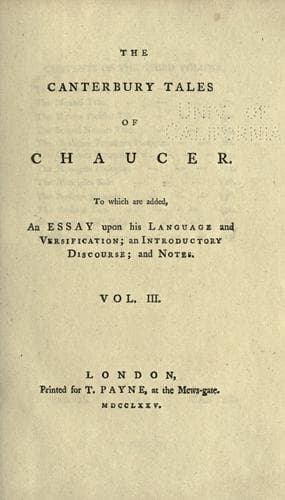
The Canterbury Tales, and Other Poems — John Shaqi
The Canterbury Tales, and Other PoemsChaucer, Geoffrey
ReligionChristian
The Canterbury Tales, and Other Poems
Chaucer, Geoffrey
Chaucer, Geoffrey, -1400; Christian pilgrims and pilgrimages -- Poetry; English poetry -- Middle English, 1100-1500
Footnotes: The original book has an average of 30 footnotes
per page. These were of three types:
(A) Glosses or explanations of obsolete words and phrases.
These have been treated as follows:
1. In the poems, they have been moved up into the right-hand
margin. Some of them have been shortened or paraphrased in
order to fit.
Explanations of single words have a single asterisk at the
end of the word and at the beginning of the explanation*. *like this
If two words in the same line have explanations
the first* has one and the second**, two. *like this **and this
Explanations of phrases have an asterisk at the
start and end *of the phrase* and of the explanation *like this*
Sometimes these glosses wrap onto the next line, still in the
right margin. If you read this e-text using a monospaced font
(like Courier in a word processor such as MS Word, or the
default font in most text editors) then the marginal notes are
right-justified.
2. In the prose tales, they have been imbedded into the text in
square brackets after the word or phrase they refer to [like this].
(B) Etymological explanations of these words. These are
indicted by a number in angle brackets in the marginal
gloss.* The note will be found at the *like this <1>
end of the poem or section.
(C) Longer notes commenting on or explaining the text. These
are indicated in the text by numbers in angle brackets thus: <1>.
The note will be found at the end of the poem or section.
Latin: Despite his declared aim of editing the tales “for popular perusal”,
Purves has left nearly all Latin quotations untranslated. I have translated
them as well as I could — any errors are my fault, not his.
PREFACE.
THE object of this volume is to place before the general reader
our two early poetic masterpieces — The Canterbury Tales and
The Faerie Queen; to do so in a way that will render their
“popular perusal” easy in a time of little leisure and unbounded
temptations to intellectual languor; and, on the same conditions,
to present a liberal and fairly representative selection from the
less important and familiar poems of Chaucer and Spenser.
There is, it may be said at the outset, peculiar advantage and
propriety in placing the two poets side by side in the manner
now attempted for the first time. Although two centuries divide
them, yet Spenser is the direct and really the immediate
successor to the poetical inheritance of Chaucer. Those two
hundred years, eventful as they were, produced no poet at all
worthy to take up the mantle that fell from Chaucer’s shoulders;
and Spenser does not need his affected archaisms, nor his
frequent and reverent appeals to “Dan Geffrey,” to vindicate for
himself a place very close to his great predecessor in the literary
history of England. If Chaucer is the “Well of English
undefiled,” Spenser is the broad and stately river that yet holds
the tenure of its very life from the fountain far away in other
and ruder scenes.
Public-domain text, read in full here on John Shaqi.
Reviews
Reviews
No reviews yet
Be the first to share your thoughts on this work.
Join the Discussion
Join the discussion
Sign in to leave a comment or review.
Sign InorCreate an account