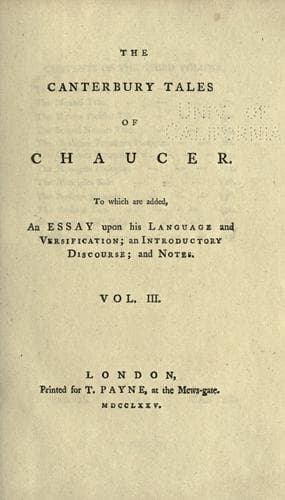
The Canterbury Tales, and Other PoemsChaucer, Geoffrey
ReligionChristian
The Canterbury Tales, and Other Poems
Chaucer, Geoffrey
Chaucer, Geoffrey, -1400; Christian pilgrims and pilgrimages -- Poetry; English poetry -- Middle English, 1100-1500
“But forth to tellen of this worthy man,
That taughte me this tale, as I began,
I say that first he with high style inditeth
(Ere he the body of his tale writeth)
A proem, in the which describeth he
Piedmont, and of Saluces <4> the country,
And speaketh of the Pennine hilles high,
That be the bounds of all West Lombardy:
And of Mount Vesulus in special,
Where as the Po out of a welle small
Taketh his firste springing and his source,
That eastward aye increaseth in his course
T’Emilia-ward, <5> to Ferraro, and Venice,
The which a long thing were to devise.* *narrate
And truely, as to my judgement,
Me thinketh it a thing impertinent,* *irrelevant
Save that he would conveye his mattere:
But this is the tale, which that ye shall hear.”
Notes to the Prologue to the Clerk’s Tale
1. Under your yerd: under your rod; as the emblem of
government or direction.
2. Francesco Petrarca, born 1304, died 1374; for his Latin epic
poem on the carer of Scipio, called “Africa,” he was solemnly
crowned with the poetic laurel in the Capitol of Rome, on
Easter-day of 1341.
3. Linian: An eminent jurist and philosopher, now almost
forgotten, who died four or five years after Petrarch.
4. Saluces: Saluzzo, a district of Savoy; its marquises were
celebrated during the Middle Ages.
5. Emilia: The region called Aemilia, across which ran the Via
Aemilia — made by M. Aemilius Lepidus, who was consul at
Rome B.C. 187. It continued the Flaminian Way from
Ariminum (Rimini) across the Po at Placentia (Piacenza) to
Mediolanum (Milan), traversing Cisalpine Gaul.
THE TALE.<1>
*Pars Prima.* *First Part*
There is, right at the west side of Itale,
Down at the root of Vesulus<2> the cold,
A lusty* plain, abundant of vitaille;* *pleasant **victuals
There many a town and tow’r thou may’st behold,
That founded were in time of fathers old,
And many another delectable sight;
And Saluces this noble country hight.
A marquis whilom lord was of that land,
As were his worthy elders* him before, *ancestors
And obedient, aye ready to his hand,
Were all his lieges, bothe less and more:
Thus in delight he liv’d, and had done yore,* *long
Belov’d and drad,* through favour of fortune, *held in reverence
Both of his lordes and of his commune.* *commonalty
Therewith he was, to speak of lineage,
The gentilest y-born of Lombardy,
A fair person, and strong, and young of age,
And full of honour and of courtesy:
Discreet enough his country for to gie,* *guide, rule
Saving in some things that he was to blame;
And Walter was this younge lordes name.
Public-domain text, read in full here on John Shaqi.
Reviews
Reviews
No reviews yet
Be the first to share your thoughts on this work.
Elsewhere in the archive
Join the Discussion
Join the discussion
Sign in to leave a comment or review.
Sign InorCreate an account