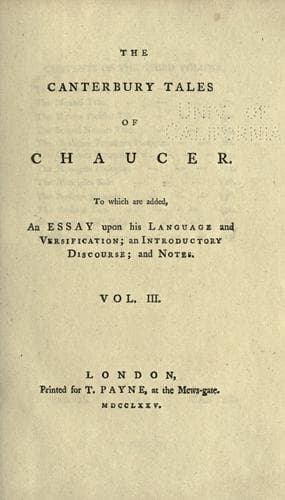
The Canterbury Tales, and Other PoemsChaucer, Geoffrey
ReligionChristian
The Canterbury Tales, and Other Poems
Chaucer, Geoffrey
Chaucer, Geoffrey, -1400; Christian pilgrims and pilgrimages -- Poetry; English poetry -- Middle English, 1100-1500
Now let us turn again to January,
That in the garden with his faire May
Singeth well merrier than the popinjay:* *parrot
“You love I best, and shall, and other none.”
So long about the alleys is he gone,
Till he was come to *that ilke perry,* *the same pear-tree*
Where as this Damian satte full merry
On high, among the freshe leaves green.
This freshe May, that is so bright and sheen,
Gan for to sigh, and said, “Alas my side!
Now, Sir,” quoth she, “for aught that may betide,
I must have of the peares that I see,
Or I must die, so sore longeth me
To eaten of the smalle peares green;
Help, for her love that is of heaven queen!
I tell you well, a woman in my plight <30>
May have to fruit so great an appetite,
That she may dien, but* she of it have. “ *unless
“Alas!” quoth he, “that I had here a knave* *servant
That coulde climb; alas! alas!” quoth he,
“For I am blind.” “Yea, Sir, *no force,”* quoth she; *no matter*
“But would ye vouchesafe, for Godde’s sake,
The perry in your armes for to take
(For well I wot that ye mistruste me),
Then would I climbe well enough,” quoth she,
“So I my foot might set upon your back.”
“Certes,” said he, “therein shall be no lack,
Might I you helpe with mine hearte’s blood.”
He stooped down, and on his back she stood,
And caught her by a twist,* and up she go’th. *twig, bough
(Ladies, I pray you that ye be not wroth,
I cannot glose,* I am a rude man): *mince matters
And suddenly anon this Damian
Gan pullen up the smock, and in he throng.* *rushed <31>
And when that Pluto saw this greate wrong,
To January he gave again his sight,
And made him see as well as ever he might.
And when he thus had caught his sight again,
Was never man of anything so fain:
But on his wife his thought was evermo’.
Up to the tree he cast his eyen two,
And saw how Damian his wife had dress’d,
In such mannere, it may not be express’d,
*But if* I woulde speak uncourteously. *unless*
And up he gave a roaring and a cry,
As doth the mother when the child shall die;
“Out! help! alas! harow!” he gan to cry;
“O stronge, lady, stowre! <32> what doest thou?”
Public-domain text, read in full here on John Shaqi.
Reviews
Reviews
No reviews yet
Be the first to share your thoughts on this work.
Elsewhere in the archive
Join the Discussion
Join the discussion
Sign in to leave a comment or review.
Sign InorCreate an account