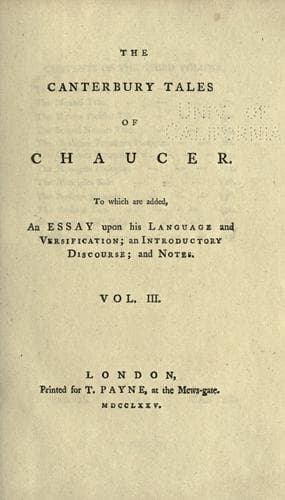
The Canterbury Tales, and Other PoemsChaucer, Geoffrey
ReligionChristian
The Canterbury Tales, and Other Poems
Chaucer, Geoffrey
Chaucer, Geoffrey, -1400; Christian pilgrims and pilgrimages -- Poetry; English poetry -- Middle English, 1100-1500
And she answered: “Sir, what aileth you?
Have patience and reason in your mind,
I have you help’d on both your eyen blind.
On peril of my soul, I shall not lien,
As me was taught to helpe with your eyen,
Was nothing better for to make you see,
Than struggle with a man upon a tree:
God wot, I did it in full good intent.”
“Struggle!” quoth he, “yea, algate* in it went. *whatever way
God give you both one shame’s death to dien!
He swived* thee; I saw it with mine eyen; *enjoyed carnally
And elles be I hanged by the halse.”* *neck
“Then is,” quoth she, “my medicine all false;
For certainly, if that ye mighte see,
Ye would not say these wordes unto me.
Ye have some glimpsing,* and no perfect sight.” *glimmering
“I see,” quoth he, “as well as ever I might,
(Thanked be God!) with both mine eyen two,
And by my faith me thought he did thee so.”
“Ye maze,* ye maze, goode Sir,” quoth she; *rave, are confused
“This thank have I for I have made you see:
Alas!” quoth she, “that e’er I was so kind.”
“Now, Dame,” quoth he, “let all pass out of mind;
Come down, my lefe,* and if I have missaid, *love
God help me so, as I am *evil apaid.* *dissatisfied*
But, by my father’s soul, I ween’d have seen
How that this Damian had by thee lain,
And that thy smock had lain upon his breast.”
“Yea, Sir,” quoth she, “ye may *ween as ye lest:* *think as you
But, Sir, a man that wakes out of his sleep, please*
He may not suddenly well take keep* *notice
Upon a thing, nor see it perfectly,
Till that he be adawed* verily. *awakened
Right so a man, that long hath blind y-be,
He may not suddenly so well y-see,
First when his sight is newe come again,
As he that hath a day or two y-seen.
Till that your sight establish’d be a while,
There may full many a sighte you beguile.
Beware, I pray you, for, by heaven’s king,
Full many a man weeneth to see a thing,
And it is all another than it seemeth;
He which that misconceiveth oft misdeemeth.”
And with that word she leapt down from the tree.
This January, who is glad but he?
He kissed her, and clipped* her full oft, *embraced
And on her womb he stroked her full soft;
And to his palace home he hath her lad.* *led
Now, goode men, I pray you to be glad.
Thus endeth here my tale of January,
God bless us, and his mother, Sainte Mary.
Notes to The Merchant’s Tale
Public-domain text, read in full here on John Shaqi.
Reviews
Reviews
No reviews yet
Be the first to share your thoughts on this work.
Elsewhere in the archive
Join the Discussion
Join the discussion
Sign in to leave a comment or review.
Sign InorCreate an account