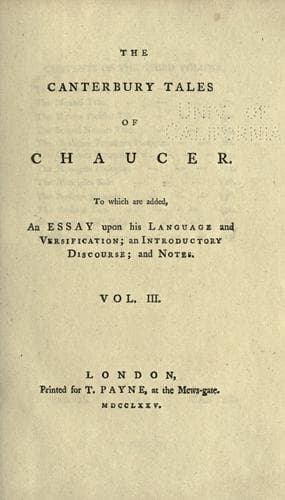
The Canterbury Tales, and Other PoemsChaucer, Geoffrey
ReligionChristian
The Canterbury Tales, and Other Poems
Chaucer, Geoffrey
Chaucer, Geoffrey, -1400; Christian pilgrims and pilgrimages -- Poetry; English poetry -- Middle English, 1100-1500
Surely the admiration of Milton might well seem to the spirit of
Chaucer to condone a much greater transgression on his domain
than this verbal change — which to both eye and ear is an
unquestionable improvement on the uncouth original.
4. Couth his colours longing for that art: well skilled in using
the colours — the word-painting — belonging to his art.
5. Aries was the mansion of Mars — to whom “his” applies.
Leo was the mansion of the Sun.
6. Sewes: Dishes, or soups. The precise force of the word is
uncertain; but it may be connected with “seethe,” to boil, and it
seems to describe a dish in which the flesh was served up amid a
kind of broth or gravy. The “sewer,” taster or assayer of the
viands served at great tables, probably derived his name from
the verb to “say” or “assay;” though Tyrwhitt would connect
the two words, by taking both from the French, “asseoir,” to
place — making the arrangement of the table the leading duty of
the “sewer,” rather than the testing of the food.
7. Heronsews: young herons; French, “heronneaux.”
8. Purpose: story, discourse; French, “propos.”
9. Gawain was celebrated in mediaeval romance as the most
courteous among King Arthur’s knights.
10. Gin: contrivance; trick; snare. Compare Italian, “inganno,”
deception; and our own “engine.”
11. Mr Wright remarks that “the making and arrangement of
seals was one of the important operations of mediaeval magic.”
12. Remued: removed; French, “remuer,” to stir.
13. Polies: Apulian. The horses of Apulia — in old French
“Poille,” in Italian “Puglia” — were held in high value.
14. The Greeke’s horse Sinon: the wooden horse of the Greek
Sinon, introduced into Troy by the stratagem of its maker.
15. Master tower: chief tower; as, in the Knight’s Tale, the
principal street is called the “master street.” See note 86 to the
Knight’s Tale.
16. Alhazen and Vitellon: two writers on optics — the first
supposed to have lived about 1100, the other about 1270.
Tyrwhitt says that their works were printed at Basle in 1572,
under the title “Alhazeni et Vitellonis Opticae.”
17. Telephus, a son of Hercules, reigned over Mysia when the
Greeks came to besiege Troy, and he sought to prevent their
landing. But, by the art of Dionysus, he was made to stumble
over a vine, and Achilles wounded him with his spear. The
oracle informed Telephus that the hurt could be healed only by
him, or by the weapon, that inflicted it; and the king, seeking
the Grecian camp, was healed by Achilles with the rust of the
charmed spear.
18. Ferne: before; a corruption of “forne,” from Anglo-Saxon,
“foran.”
19. Aldrian: or Aldebaran; a star in the neck of the constellation
Leo.
20. Chamber of parements: Presence-chamber, or chamber of
state, full of splendid furniture and ornaments. The same
expression is used in French and Italian.
Public-domain text, read in full here on John Shaqi.
Reviews
Reviews
No reviews yet
Be the first to share your thoughts on this work.
Elsewhere in the archive
Join the Discussion
Join the discussion
Sign in to leave a comment or review.
Sign InorCreate an account