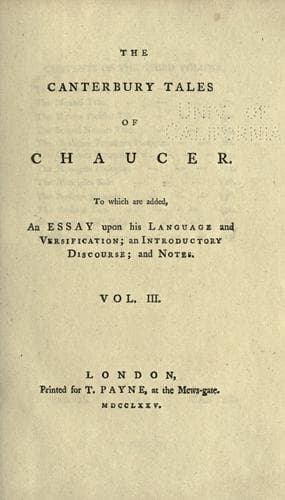
The Canterbury Tales, and Other PoemsChaucer, Geoffrey
ReligionChristian
The Canterbury Tales, and Other Poems
Chaucer, Geoffrey
Chaucer, Geoffrey, -1400; Christian pilgrims and pilgrimages -- Poetry; English poetry -- Middle English, 1100-1500
21. In Pisces, Venus was said to be at her exaltation or greatest
power. A planet, according to the old astrologers, was in
“exaltation” when in the sign of the Zodiac in which it exerted
its strongest influence; the opposite sign, in which it was
weakest, was called its “dejection.”
22. Launcelot: Arthur’s famous knight, so accomplished and
courtly, that he was held the very pink of chivalry.
23. Trill: turn; akin to “thirl”, “drill.”
24. Ride: another reading is “bide,” alight or remain.
25. Feastying: entertaining; French, “festoyer,” to feast.
26. The old physicians held that blood dominated in the human
body late at night and in the early morning. Galen says that the
domination lasts for seven hours.
27. Fumosity: fumes of wine rising from the stomach to the
head.
28. Fremde: foreign, strange; German, “fremd” in the northern
dialects, “frem,” or “fremmed,” is used in the same sense.
29. Leden: Language, dialect; from Anglo-Saxon, “leden” or
“laeden,” a corruption from “Latin.”
30. Tercelet: the “tassel,” or male of any species of hawk; so
called, according to Cotgrave, because he is one third (“tiers”)
smaller than the female.
31. “And Lamech took unto him two wives: the name of the
one Adah, and the name of the other Zillah” (Gen. iv. 19).
32. Galoche: shoe; it seems to have been used in France, of a
“sabot,” or wooden shoe. The reader cannot fail to recall the
same illustration in John i. 27, where the Baptist says of Christ:
“He it is, who coming after me is preferred before me; whose
shoe’s latchet I am not worthy to unloose.”
33. Byleve; stay; another form is “bleve;” from Anglo-Saxon,
“belitan,” to remain. Compare German, “bleiben.”
34. This sentiment, as well as the illustration of the bird which
follows, is taken from the third book of Boethius, “De
Consolatione Philosophiae,” metrum 2. It has thus been
rendered in Chaucer’s translation: “All things seek aye to their
proper course, and all things rejoice on their returning again to
their nature.”
35. Men love of proper kind newfangleness: Men, by their own
— their very — nature, are fond of novelty, and prone to
inconstancy.
36. Blue was the colour of truth, as green was that of
inconstancy. In John Stowe’s additions to Chaucer’s works,
printed in 1561, there is “A balade whiche Chaucer made
against women inconstaunt,” of which the refrain is, “In stead of
blue, thus may ye wear all green.”
Public-domain text, read in full here on John Shaqi.
Reviews
Reviews
No reviews yet
Be the first to share your thoughts on this work.
Elsewhere in the archive
Join the Discussion
Join the discussion
Sign in to leave a comment or review.
Sign InorCreate an account