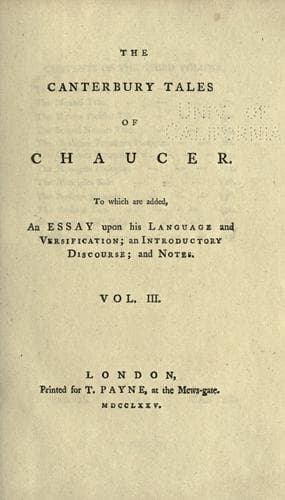
The Canterbury Tales, and Other PoemsChaucer, Geoffrey
ReligionChristian
The Canterbury Tales, and Other Poems
Chaucer, Geoffrey
Chaucer, Geoffrey, -1400; Christian pilgrims and pilgrimages -- Poetry; English poetry -- Middle English, 1100-1500
To love me best; God wot ye saide so,
Albeit that I unworthy am thereto;
Madame, I speak it for th’ honour of you,
More than to save my hearte’s life right now;
I have done so as ye commanded me,
And if ye vouchesafe, ye may go see.
Do as you list, have your behest in mind,
For, quick or dead, right there ye shall me find;
In you hes all to *do me live or dey;* *cause me to
But well I wot the rockes be away.” live or die*
He took his leave, and she astonish’d stood;
In all her face was not one drop of blood:
She never ween’d t’have come in such a trap.
“Alas!” quoth she, “that ever this should hap!
For ween’d I ne’er, by possibility,
That such a monster or marvail might be;
It is against the process of nature.”
And home she went a sorrowful creature;
For very fear unnethes* may she go. *scarcely
She weeped, wailed, all a day or two,
And swooned, that it ruthe was to see:
But why it was, to no wight tolde she,
For out of town was gone Arviragus.
But to herself she spake, and saide thus,
With face pale, and full sorrowful cheer,
In her complaint, as ye shall after hear.
“Alas!” quoth she, “on thee, Fortune, I plain,* *complain
That unware hast me wrapped in thy chain,
From which to scape, wot I no succour,
Save only death, or elles dishonour;
One of these two behoveth me to choose.
But natheless, yet had I lever* lose *sooner, rather
My life, than of my body have shame,
Or know myselfe false, or lose my name;
And with my death *I may be quit y-wis.* *I may certainly purchase
Hath there not many a noble wife, ere this, my exemption*
And many a maiden, slain herself, alas!
Rather than with her body do trespass?
Yes, certes; lo, these stories bear witness. <22>
When thirty tyrants full of cursedness* *wickedness
Had slain Phidon in Athens at the feast,
They commanded his daughters to arrest,
And bringe them before them, in despite,
All naked, to fulfil their foul delight;
And in their father’s blood they made them dance
Upon the pavement, — God give them mischance.
For which these woeful maidens, full of dread,
Rather than they would lose their maidenhead,
They privily *be start* into a well, *suddenly leaped
And drowned themselves, as the bookes tell.
They of Messene let inquire and seek
Of Lacedaemon fifty maidens eke,
On which they woulde do their lechery:
But there was none of all that company
That was not slain, and with a glad intent
Chose rather for to die, than to assent
To be oppressed* of her maidenhead. *forcibly bereft
Why should I then to dien be in dread?
Lo, eke the tyrant Aristoclides,
That lov’d a maiden hight Stimphalides,
When that her father slain was on a night,
Unto Diana’s temple went she right,
And hent* the image in her handes two, *caught, clasped
From which image she woulde never go;
Public-domain text, read in full here on John Shaqi.
Reviews
Reviews
No reviews yet
Be the first to share your thoughts on this work.
Elsewhere in the archive
Join the Discussion
Join the discussion
Sign in to leave a comment or review.
Sign InorCreate an account