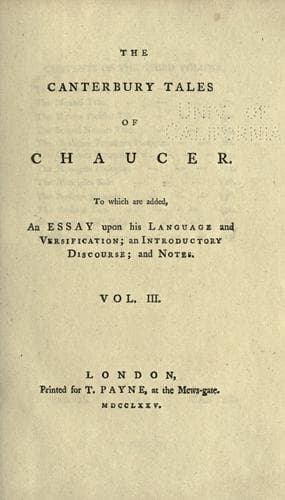
The Canterbury Tales, and Other PoemsChaucer, Geoffrey
ReligionChristian
The Canterbury Tales, and Other Poems
Chaucer, Geoffrey
Chaucer, Geoffrey, -1400; Christian pilgrims and pilgrimages -- Poetry; English poetry -- Middle English, 1100-1500
This maid, of which I tell my tale express,
She kept herself, her needed no mistress;
For in her living maidens mighte read,
As in a book, ev’ry good word and deed
That longeth to a maiden virtuous;
She was so prudent and so bounteous.
For which the fame out sprang on every side
Both of her beauty and her bounte* wide: *goodness
That through the land they praised her each one
That loved virtue, save envy alone,
That sorry is of other manne’s weal,
And glad is of his sorrow and unheal* — *misfortune
The Doctor maketh this descriptioun. — <5>
This maiden on a day went in the town
Toward a temple, with her mother dear,
As is of younge maidens the mannere.
Now was there then a justice in that town,
That governor was of that regioun:
And so befell, this judge his eyen cast
Upon this maid, avising* her full fast, *observing
As she came forth by where this judge stood;
Anon his hearte changed and his mood,
So was he caught with beauty of this maid
And to himself full privily he said,
“This maiden shall be mine *for any man.”* *despite what any
Anon the fiend into his hearte ran, man may do*
And taught him suddenly, that he by sleight
This maiden to his purpose winne might.
For certes, by no force, nor by no meed,* *bribe, reward
Him thought he was not able for to speed;
For she was strong of friendes, and eke she
Confirmed was in such sov’reign bounte,
That well he wist he might her never win,
As for to make her with her body sin.
For which, with great deliberatioun,
He sent after a clerk <6> was in the town,
The which he knew for subtle and for bold.
This judge unto this clerk his tale told
In secret wise, and made him to assure
He shoulde tell it to no creature,
And if he did, he shoulde lose his head.
And when assented was this cursed rede,* *counsel, plot
Glad was the judge, and made him greate cheer,
And gave him giftes precious and dear.
When shapen* was all their conspiracy *arranged
From point to point, how that his lechery
Performed shoulde be full subtilly,
As ye shall hear it after openly,
Home went this clerk, that highte Claudius.
This false judge, that highte Appius, —
(So was his name, for it is no fable,
But knowen for a storial* thing notable; *historical, authentic
The sentence* of it sooth** is out of doubt); — *account **true
This false judge went now fast about
To hasten his delight all that he may.
And so befell, soon after on a day,
This false judge, as telleth us the story,
As he was wont, sat in his consistory,
And gave his doomes* upon sundry case’; *judgments
This false clerk came forth *a full great pace,* *in haste
And saide; Lord, if that it be your will,
As do me right upon this piteous bill,* *petition
In which I plain upon Virginius.
And if that he will say it is not thus,
Public-domain text, read in full here on John Shaqi.
Reviews
Reviews
No reviews yet
Be the first to share your thoughts on this work.
Elsewhere in the archive
Join the Discussion
Join the discussion
Sign in to leave a comment or review.
Sign InorCreate an account