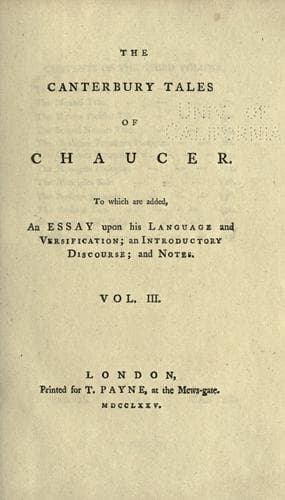
The Canterbury Tales, and Other PoemsChaucer, Geoffrey
ReligionChristian
The Canterbury Tales, and Other Poems
Chaucer, Geoffrey
Chaucer, Geoffrey, -1400; Christian pilgrims and pilgrimages -- Poetry; English poetry -- Middle English, 1100-1500
I will it prove, and finde good witness,
That sooth is what my bille will express.”
The judge answer’d, “Of this, in his absence,
I may not give definitive sentence.
Let do* him call, and I will gladly hear; *cause
Thou shalt have alle right, and no wrong here.”
Virginius came to weet* the judge’s will, *know, learn
And right anon was read this cursed bill;
The sentence of it was as ye shall hear
“To you, my lord, Sir Appius so clear,
Sheweth your poore servant Claudius,
How that a knight called Virginius,
Against the law, against all equity,
Holdeth, express against the will of me,
My servant, which that is my thrall* by right, *slave
Which from my house was stolen on a night,
While that she was full young; I will it preve* *prove
By witness, lord, so that it you *not grieve;* *be not displeasing*
She is his daughter not, what so he say.
Wherefore to you, my lord the judge, I pray,
Yield me my thrall, if that it be your will.”
Lo, this was all the sentence of the bill.
Virginius gan upon the clerk behold;
But hastily, ere he his tale told,
And would have proved it, as should a knight,
And eke by witnessing of many a wight,
That all was false that said his adversary,
This cursed judge would no longer tarry,
Nor hear a word more of Virginius,
But gave his judgement, and saide thus:
“I deem* anon this clerk his servant have; *pronounce, determine
Thou shalt no longer in thy house her save.
Go, bring her forth, and put her in our ward
The clerk shall have his thrall: thus I award.”
And when this worthy knight, Virginius,
Through sentence of this justice Appius,
Muste by force his deare daughter give
Unto the judge, in lechery to live,
He went him home, and sat him in his hall,
And let anon his deare daughter call;
And with a face dead as ashes cold
Upon her humble face he gan behold,
With father’s pity sticking* through his heart, *piercing
All* would he from his purpose not convert.** *although **turn aside
“Daughter,” quoth he, “Virginia by name,
There be two wayes, either death or shame,
That thou must suffer, — alas that I was bore!* *born
For never thou deservedest wherefore
To dien with a sword or with a knife,
O deare daughter, ender of my life,
Whom I have foster’d up with such pleasance
That thou were ne’er out of my remembrance;
O daughter, which that art my laste woe,
And in this life my laste joy also,
O gem of chastity, in patience
Take thou thy death, for this is my sentence:
For love and not for hate thou must be dead;
My piteous hand must smiten off thine head.
Alas, that ever Appius thee say!* *saw
Thus hath he falsely judged thee to-day.”
And told her all the case, as ye before
Have heard; it needeth not to tell it more.
Public-domain text, read in full here on John Shaqi.
Reviews
Reviews
No reviews yet
Be the first to share your thoughts on this work.
Elsewhere in the archive
Join the Discussion
Join the discussion
Sign in to leave a comment or review.
Sign InorCreate an account