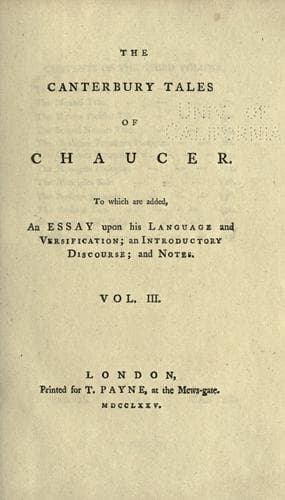
The Canterbury Tales, and Other PoemsChaucer, Geoffrey
ReligionChristian
The Canterbury Tales, and Other Poems
Chaucer, Geoffrey
Chaucer, Geoffrey, -1400; Christian pilgrims and pilgrimages -- Poetry; English poetry -- Middle English, 1100-1500
NOT in point of genius only, but even in point of time, Chaucer
may claim the proud designation of “first” English poet. He
wrote “The Court of Love” in 1345, and “The Romaunt of the
Rose,” if not also “Troilus and Cressida,” probably within the
next decade: the dates usually assigned to the poems of
Laurence Minot extend from 1335 to 1355, while “The Vision
of Piers Plowman” mentions events that occurred in 1360 and
1362 — before which date Chaucer had certainly written “The
Assembly of Fowls” and his “Dream.” But, though they were
his contemporaries, neither Minot nor Langland (if Langland
was the author of the Vision) at all approached Chaucer in the
finish, the force, or the universal interest of their works and the
poems of earlier writer; as Layamon and the author of the
“Ormulum,” are less English than Anglo-Saxon or Anglo-
Norman. Those poems reflected the perplexed struggle for
supremacy between the two grand elements of our language,
which marked the twelfth and thirteenth centuries; a struggle
intimately associated with the political relations between the
conquering Normans and the subjugated Anglo-Saxons.
Chaucer found two branches of the language; that spoken by
the people, Teutonic in its genius and its forms; that spoken by
the learned and the noble, based on the French Yet each branch
had begun to borrow of the other — just as nobles and people
had been taught to recognise that each needed the other in the
wars and the social tasks of the time; and Chaucer, a scholar, a
courtier, a man conversant with all orders of society, but
accustomed to speak, think, and write in the words of the
highest, by his comprehensive genius cast into the simmering
mould a magical amalgamant which made the two half-hostile
elements unite and interpenetrate each other. Before Chaucer
wrote, there were two tongues in England, keeping alive the
feuds and resentments of cruel centuries; when he laid down his
pen, there was practically but one speech — there was, and ever
since has been, but one people.
Public-domain text, read in full here on John Shaqi.
Reviews
Reviews
No reviews yet
Be the first to share your thoughts on this work.
Join the Discussion
Join the discussion
Sign in to leave a comment or review.
Sign InorCreate an account