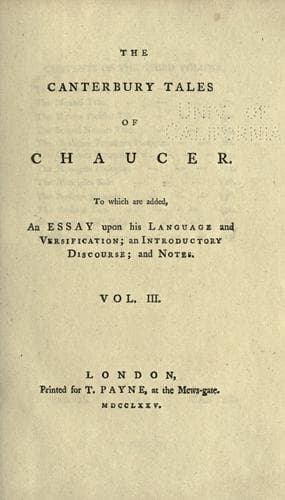
The Canterbury Tales, and Other PoemsChaucer, Geoffrey
ReligionChristian
The Canterbury Tales, and Other Poems
Chaucer, Geoffrey
Chaucer, Geoffrey, -1400; Christian pilgrims and pilgrimages -- Poetry; English poetry -- Middle English, 1100-1500
By process and by length of certain years
All stinted* is the mourning and the tears *ended
Of Greekes, by one general assent.
Then seemed me there was a parlement
At Athens, upon certain points and cas*: *cases
Amonge the which points y-spoken was
To have with certain countries alliance,
And have of Thebans full obeisance.
For which this noble Theseus anon
Let* send after the gentle Palamon, *caused
Unwist* of him what was the cause and why: *unknown
But in his blacke clothes sorrowfully
He came at his commandment *on hie*; *in haste*
Then sente Theseus for Emily.
When they were set*, and hush’d was all the place *seated
And Theseus abided* had a space *waited
Ere any word came from his wise breast
*His eyen set he there as was his lest*, *he cast his eyes
And with a sad visage he sighed still, wherever he pleased*
And after that right thus he said his will.
“The firste mover of the cause above
When he first made the faire chain of love,
Great was th’ effect, and high was his intent;
Well wist he why, and what thereof he meant:
For with that faire chain of love he bond* *bound
The fire, the air, the water, and the lond
In certain bondes, that they may not flee:<91>
That same prince and mover eke,” quoth he,
“Hath stablish’d, in this wretched world adown,
Certain of dayes and duration
To all that are engender’d in this place,
Over the whiche day they may not pace*, *pass
All may they yet their dayes well abridge.
There needeth no authority to allege
For it is proved by experience;
But that me list declare my sentence*. *opinion
Then may men by this order well discern,
That thilke* mover stable is and etern. *the same
Well may men know, but that it be a fool,
That every part deriveth from its whole.
For nature hath not ta’en its beginning
Of no *partie nor cantle* of a thing, *part or piece*
But of a thing that perfect is and stable,
Descending so, till it be corruptable.
And therefore of His wise purveyance* *providence
He hath so well beset* his ordinance,
That species of things and progressions
Shallen endure by successions,
And not etern, withouten any lie:
This mayst thou understand and see at eye.
Lo th’ oak, that hath so long a nourishing
From the time that it ’ginneth first to spring,
And hath so long a life, as ye may see,
Yet at the last y-wasted is the tree.
Consider eke, how that the harde stone
Under our feet, on which we tread and gon*, *walk
Yet wasteth, as it lieth by the way.
The broade river some time waxeth drey*. *dry
The greate townes see we wane and wend*. *go, disappear
Then may ye see that all things have an end.
Public-domain text, read in full here on John Shaqi.
Reviews
Reviews
No reviews yet
Be the first to share your thoughts on this work.
Elsewhere in the archive
Join the Discussion
Join the discussion
Sign in to leave a comment or review.
Sign InorCreate an account