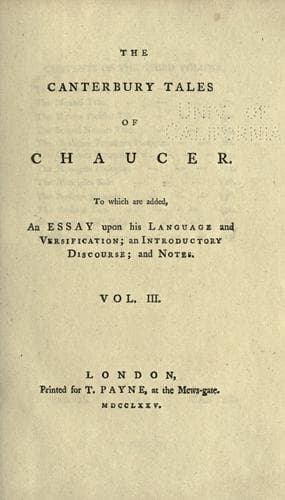
The Canterbury Tales, and Other PoemsChaucer, Geoffrey
ReligionChristian
The Canterbury Tales, and Other Poems
Chaucer, Geoffrey
Chaucer, Geoffrey, -1400; Christian pilgrims and pilgrimages -- Poetry; English poetry -- Middle English, 1100-1500
Of man and woman see we well also, —
That needes in one of the termes two, —
That is to say, in youth or else in age,-
He must be dead, the king as shall a page;
Some in his bed, some in the deepe sea,
Some in the large field, as ye may see:
There helpeth nought, all go that ilke* way: *same
Then may I say that alle thing must die.
What maketh this but Jupiter the king?
The which is prince, and cause of alle thing,
Converting all unto his proper will,
From which it is derived, sooth to tell
And hereagainst no creature alive,
Of no degree, availeth for to strive.
Then is it wisdom, as it thinketh me,
To make a virtue of necessity,
And take it well, that we may not eschew*, *escape
And namely what to us all is due.
And whoso grudgeth* ought, he doth folly, *murmurs at
And rebel is to him that all may gie*. *direct, guide
And certainly a man hath most honour
To dien in his excellence and flower,
When he is sicker* of his goode name. *certain
Then hath he done his friend, nor him*, no shame *himself
And gladder ought his friend be of his death,
When with honour is yielded up his breath,
Than when his name *appalled is for age*; *decayed by old age*
For all forgotten is his vassalage*. *valour, service
Then is it best, as for a worthy fame,
To dien when a man is best of name.
The contrary of all this is wilfulness.
Why grudge we, why have we heaviness,
That good Arcite, of chivalry the flower,
Departed is, with duty and honour,
Out of this foule prison of this life?
Why grudge here his cousin and his wife
Of his welfare, that loved him so well?
Can he them thank? nay, God wot, neverdeal*, — *not a jot
That both his soul and eke themselves offend*, *hurt
And yet they may their lustes* not amend**. *desires **control
What may I conclude of this longe serie*, *string of remarks
But after sorrow I rede* us to be merry, *counsel
And thanke Jupiter for all his grace?
And ere that we departe from this place,
I rede that we make of sorrows two
One perfect joye lasting evermo’:
And look now where most sorrow is herein,
There will I first amenden and begin.
“Sister,” quoth he, “this is my full assent,
With all th’ advice here of my parlement,
That gentle Palamon, your owen knight,
That serveth you with will, and heart, and might,
And ever hath, since first time ye him knew,
That ye shall of your grace upon him rue*, *take pity
And take him for your husband and your lord:
Lend me your hand, for this is our accord.
*Let see* now of your womanly pity. *make display*
He is a kinge’s brother’s son, pardie*. *by God
And though he were a poore bachelere,
Since he hath served you so many a year,
And had for you so great adversity,
It muste be considered, *’lieveth me*.
Public-domain text, read in full here on John Shaqi.
Reviews
Reviews
No reviews yet
Be the first to share your thoughts on this work.
Elsewhere in the archive
Join the Discussion
Join the discussion
Sign in to leave a comment or review.
Sign InorCreate an account