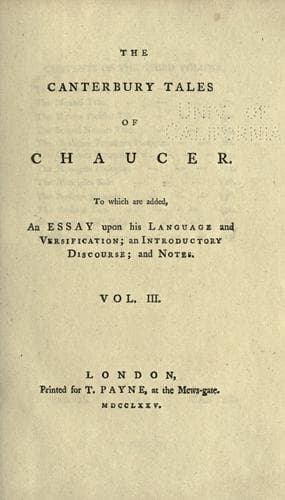
The Canterbury Tales, and Other PoemsChaucer, Geoffrey
ReligionChristian
The Canterbury Tales, and Other Poems
Chaucer, Geoffrey
Chaucer, Geoffrey, -1400; Christian pilgrims and pilgrimages -- Poetry; English poetry -- Middle English, 1100-1500
It is a sin, and eke a great folly
To apeiren* any man, or him defame, *injure
And eke to bringe wives in evil name.
Thou may’st enough of other thinges sayn.”
This drunken Miller spake full soon again,
And saide, “Leve brother Osewold,
Who hath no wife, he is no cuckold.
But I say not therefore that thou art one;
There be full goode wives many one.
Why art thou angry with my tale now?
I have a wife, pardie, as well as thou,
Yet *n’old I*, for the oxen in my plough, *I would not*
Taken upon me more than enough,
To deemen* of myself that I am one; *judge
I will believe well that I am none.
An husband should not be inquisitive
Of Godde’s privity, nor of his wife.
So he may finde Godde’s foison* there, *treasure
Of the remnant needeth not to enquere.”
What should I more say, but that this Millere
He would his wordes for no man forbear,
But told his churlish* tale in his mannere; *boorish, rude
Me thinketh, that I shall rehearse it here.
And therefore every gentle wight I pray,
For Godde’s love to deem not that I say
Of evil intent, but that I must rehearse
Their tales all, be they better or worse,
Or elles falsen* some of my mattere. *falsify
And therefore whoso list it not to hear,
Turn o’er the leaf, and choose another tale;
For he shall find enough, both great and smale,
Of storial* thing that toucheth gentiless, *historical, true
And eke morality and holiness.
Blame not me, if that ye choose amiss.
The Miller is a churl, ye know well this,
So was the Reeve, with many other mo’,
And harlotry* they tolde bothe two. *ribald tales
*Avise you* now, and put me out of blame; *be warned*
And eke men should not make earnest of game*. *jest, fun
Notes to the Prologue to the Miller’s Tale
1. Pilate, an unpopular personage in the mystery-plays of the
middle ages, was probably represented as having a gruff, harsh
voice.
2. Wite: blame; in Scotland, “to bear the wyte,” is to bear the
blame.
THE TALE.
Whilom there was dwelling in Oxenford
A riche gnof*, that *guestes held to board*, *miser *took in boarders*
And of his craft he was a carpenter.
With him there was dwelling a poor scholer,
Had learned art, but all his fantasy
Was turned for to learn astrology.
He coude* a certain of conclusions *knew
To deeme* by interrogations, *determine
If that men asked him in certain hours,
When that men should have drought or elles show’rs:
Or if men asked him what shoulde fall
Of everything, I may not reckon all.
Public-domain text, read in full here on John Shaqi.
Reviews
Reviews
No reviews yet
Be the first to share your thoughts on this work.
Elsewhere in the archive
Join the Discussion
Join the discussion
Sign in to leave a comment or review.
Sign InorCreate an account