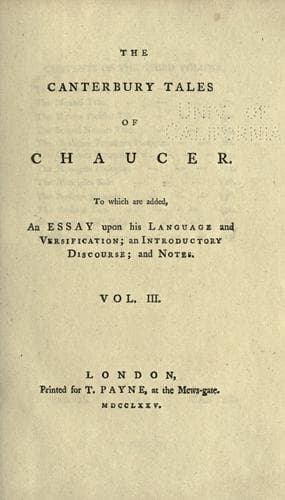
The Canterbury Tales, and Other PoemsChaucer, Geoffrey
ReligionChristian
The Canterbury Tales, and Other Poems
Chaucer, Geoffrey
Chaucer, Geoffrey, -1400; Christian pilgrims and pilgrimages -- Poetry; English poetry -- Middle English, 1100-1500
89. It was the custom for soldiers to march thrice around the
funeral pile of an emperor or general; “on the left hand” is
added, in reference to the belief that the left hand was
propitious — the Roman augur turning his face southward, and
so placing on his left hand the east, whence good omens came.
With the Greeks, however, their augurs facing the north, it was
just the contrary. The confusion, frequent in classical writers, is
complicated here by the fact that Chaucer’s description of the
funeral of Arcite is taken from Statius’ “Thebaid” — from a
Roman’s account of a Greek solemnity.
90. Lyke-wake: watching by the remains of the dead; from
Anglo-Saxon, “lice,” a corpse; German, “Leichnam.”
91. Chaucer here borrows from Boethius, who says:
“Hanc rerum seriem ligat,
Terras ac pelagus regens,
Et coelo imperitans, amor.”
(Love ties these things together: the earth, and the ruling sea,
and the imperial heavens)
THE MILLER’S TALE.
THE PROLOGUE.
When that the Knight had thus his tale told
In all the rout was neither young nor old,
That he not said it was a noble story,
And worthy to be *drawen to memory*; *recorded*
And *namely the gentles* every one. *especially the gentlefolk*
Our Host then laugh’d and swore, “So may I gon,* *prosper
This goes aright; *unbuckled is the mail;* *the budget is opened*
Let see now who shall tell another tale:
For truely this game is well begun.
Now telleth ye, Sir Monk, if that ye conne*, *know
Somewhat, to quiten* with the Knighte’s tale.” *match
The Miller that fordrunken was all pale,
So that unnethes* upon his horse he sat, *with difficulty
He would avalen* neither hood nor hat, *uncover
Nor abide* no man for his courtesy, *give way to
But in Pilate’s voice<1> he gan to cry,
And swore by armes, and by blood, and bones,
“I can a noble tale for the nones* *occasion,
With which I will now quite* the Knighte’s tale.” *match
Our Host saw well how drunk he was of ale,
And said; “Robin, abide, my leve* brother, *dear
Some better man shall tell us first another:
Abide, and let us worke thriftily.”
By Godde’s soul,” quoth he, “that will not I,
For I will speak, or elles go my way!”
Our Host answer’d; “*Tell on a devil way*; *devil take you!*
Thou art a fool; thy wit is overcome.”
“Now hearken,” quoth the Miller, “all and some:
But first I make a protestatioun.
That I am drunk, I know it by my soun’:
And therefore if that I misspeak or say,
*Wite it* the ale of Southwark, I you pray: *blame it on*<2>
For I will tell a legend and a life
Both of a carpenter and of his wife,
How that a clerk hath *set the wrighte’s cap*.” *fooled the carpenter*
The Reeve answer’d and saide, “*Stint thy clap*, *hold your tongue*
Let be thy lewed drunken harlotry.
Public-domain text, read in full here on John Shaqi.
Reviews
Reviews
No reviews yet
Be the first to share your thoughts on this work.
Elsewhere in the archive
Join the Discussion
Join the discussion
Sign in to leave a comment or review.
Sign InorCreate an account