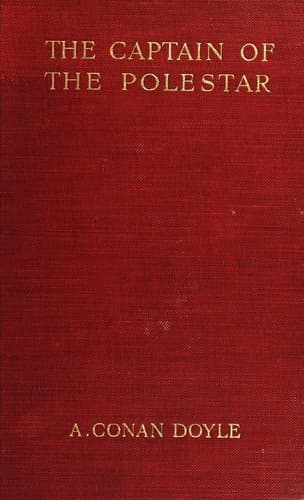
The Captain of the Polestar, and Other TalesDoyle, Arthur Conan
General
The Captain of the Polestar, and Other Tales
Doyle, Arthur Conan
Great Britain -- Social life and customs -- 19th century -- Fiction; Short stories, English
“My lads,” he said, “no doubt you think I brought you into this fix, if
it is a fix, and maybe some of you feel bitter against me on account of
it. But you must remember that for many a season no ship that comes to
the country has brought in as much oil-money as the old Pole-Star,
and every one of you has had his share of it. You can leave your wives
behind you in comfort while other poor fellows come back to find their
lasses on the parish. If you have to thank me for the one you have to
thank me for the other, and we may call it quits. We’ve tried a bold
venture before this and succeeded, so now that we’ve tried one and
failed we’ve no cause to cry out about it. If the worst comes to the
worst, we can make the land across the ice, and lay in a stock of
seals which will keep us alive until the spring. It won’t come to that,
though, for you’ll see the Scotch coast again before three weeks are
out. At present every man must go on half rations, share and share
alike, and no favour to any. Keep up your hearts and you’ll pull through
this as you’ve pulled through many a danger before.” These few
simple words of his had a wonderful effect upon the crew. His former
unpopularity was forgotten, and the old harpooner whom I have already
mentioned for his superstition, led off three cheers, which were
heartily joined in by all hands.
September 16th.--The wind has veered round to the north during the
night, and the ice shows some symptoms of opening out. The men are in
a good humour in spite of the short allowance upon which they have been
placed. Steam is kept up in the engine-room, that there may be no delay
should an opportunity for escape present itself. The Captain is in
exuberant spirits, though he still retains that wild “fey” expression
which I have already remarked upon. This burst of cheerfulness puzzles
me more than his former gloom. I cannot understand it. I think I
mentioned in an early part of this journal that one of his oddities is
that he never permits any person to enter his cabin, but insists upon
making his own bed, such as it is, and performing every other office for
himself. To my surprise he handed me the key to-day and requested me to
go down there and take the time by his chronometer while he measured
the altitude of the sun at noon. It is a bare little room, containing
a washing-stand and a few books, but little else in the way of luxury,
except some pictures upon the walls. The majority of these are small
cheap oleographs, but there was one water-colour sketch of the head of a
young lady which arrested my attention. It was evidently a portrait, and
not one of those fancy types of female beauty which sailors particularly
affect. No artist could have evolved from his own mind such a curious
mixture of character and weakness. The languid, dreamy eyes, with their
drooping lashes, and the broad, low brow, unruffled by thought or care,
were in strong contrast with the clean-cut, prominent jaw, and the
resolute set of the lower lip.
Public-domain text, read in full here on John Shaqi.
Reviews
Reviews
No reviews yet
Be the first to share your thoughts on this work.
Join the Discussion
Join the discussion
Sign in to leave a comment or review.
Sign InorCreate an account