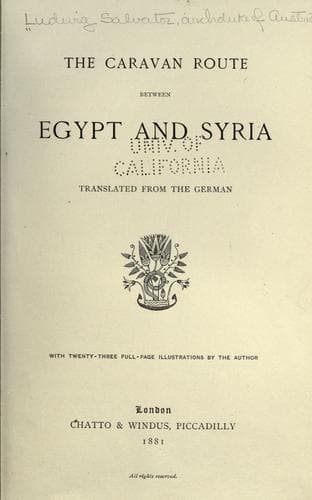
The Caravan Route between Egypt and Syria — John Shaqi
The Caravan Route between Egypt and SyriaLudwig Salvator, Archduke of Austria
History
The Caravan Route between Egypt and Syria
Ludwig Salvator, Archduke of Austria
Palestine -- Description and travel
Our tents were soon in order, and under their shelter we at last enjoyed
our rest. Before sunset we saw our animals return from El Kantara.
Horses and mules were then re-saddled and fastened together in a
straight line to a long rope. Their shadows, thrown by the moon upon the
sand, were extremely grotesque. We could now count them at our leisure.
There were seven horses, five mules, and three donkeys. The camels,
seven in number, were allowed to wander freely over the desert. To an
inexperienced traveller their huge forms on the vast plain, in a dark
night, have the appearance of ghastly phantoms. Our moukri and the
camel-drivers had lighted a big fire, and were now stretched out at full
length around it. We had four moukri, one of whom was a Persian named
Ahsen, and two camel-drivers, Daud and Hassan, both from El Harish. We
heard Abou Nabout's voice every now and then in the kitchen tent for
some little time, but complete peace soon reigned, and it was not long
before our little camp were fast asleep.
II.
TO BIR EL NUS AND KATYA.
The camels left the camp the first thing in the morning, that they might
have a good start of us, and by half-past seven o'clock the luggage was
disposed of, and we were again in the saddle. The traces of our sojourn
were still visible upon the moving sand, but would in all probability
become obliterated soon after our departure. It was a glorious day, and
we felt braced and invigorated by the pure air of the desert. Proceeding
through a uniform plain covered with purslane bushes, we saw rising in
the distance to our right, or south-east, the Jebel Abou Assab,
"Mountains of the father of the sugar-cane." From the more elevated
spots of the undulating surface we could see two steamers passing up the
canal, one of which was Austrian. The spectacle of these enormous
vessels, with their tall masts, majestically advancing to all appearance
through a sea of sand (for the canal itself was invisible), had a most
singular effect, and made us appreciate anew the wonderful character of
M. De Lesseps's grand undertaking. It was not long, however, before the
highest masts disappeared like phantoms behind the sandy waves through
which our path lay. After passing a small hillock on our right, called
Gerba--"water skin," we reached an undulating piece of ground commanding
a view of the mountains above referred to, and of the group of palms
known as Zaega--"the Beautiful." At the same time the scene was
agreeably relieved by one of those phenomena so common in the desert. A
beautiful mirage became gradually developed to our left, displaying the
reflection of a large lake, with its irregular outline, and even showing
with marvellous vividness the ruffled surface of the water. At some
distance we observed several Bedouins, and not far from us some of their
women, most of whom were engaged in leading black goats to their scanty
pasturage.
Public-domain text, read in full here on John Shaqi.
Reviews
Reviews
No reviews yet
Be the first to share your thoughts on this work.
Join the Discussion
Join the discussion
Sign in to leave a comment or review.
Sign InorCreate an account