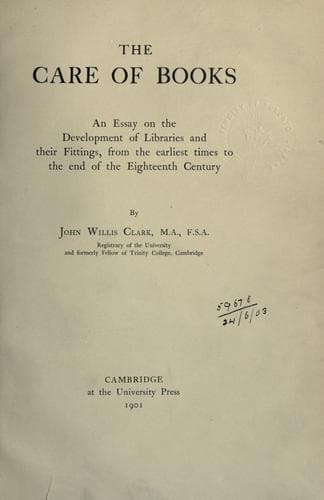
Libraries -- History; Library architecture -- History; Library fittings and supplies -- History
Come, no more single lines--let him bring all,
His wife, his children, his Cephisophon,
His books and everything, himself to boot--
I'll counterpoise them with a couple of lines[9].
With regard to Aristotle Strabo has preserved a tradition that he "was the
first who made a collection of books, and taught the kings of Egypt how to
arrange a library[10]"--words which may be taken to mean that Aristotle
was the first to work out the arrangement of books on a definite system
which was afterwards adopted by the Ptolemies at Alexandria.
These notices are extremely disappointing. They merely serve to shew that
collections of books did exist in Greece; but they give us no indication
of either their extent or their arrangement. It was left to the Emperor
Hadrian to build the first public library at Athens, to which, as it was
naturally constructed on a Roman design, I shall return after I have
described those from which it was in all probability imitated.
But, if what may be termed Greece in Europe declines to give us
information, that other Greece which extended itself to Asia Minor and to
Egypt--Greater Greece it would be called in modern times--supplies us with
a type of library-organisation which has been of far-reaching influence.
After the death of Alexander the Great (B.C. 323) a Greek dynasty, that of
the Ptolemies, established itself at Alexandria, and another Greek dynasty
at Pergamon. Both were distinguished--like Italian despots of the
Renaissance--for the splendour and the culture of their courts, and they
rivalled one another in the extent and richness of their libraries; but,
if we are to believe Strabo, the library at Pergamon was not begun until
the reign of Eumenes II. (B.C. 197-159), or 126 years after that at
Alexandria[11].
The libraries at Alexandria (for there were two)--though far more
celebrated and more extensive than the library at Pergamon--need not, from
my point of view, detain us for more than a moment, for we are told very
little about their position, and nothing about their arrangement. The site
of the earliest, the foundation of which is ascribed to Ptolemy the Second
(B.C. 285-247), must undoubtedly be sought for within the circuit of the
royal palace, which was in the fashionable quarter of the city called
Brucheion. This palace was a vast enceinte, not a separate building, and,
as Strabo, who visited Alexandria 24 B.C., says,
Within the precincts of the palace is the Museum. It has
a colonnade, a lecture-room, and a vast establishment
where the men of letters who share the use of the Museum
take their meals together. This College has a common
revenue; and is managed by a priest who is over the
Museum, an officer formerly appointed by the kings of
Egypt, but, at the present time, by the Emperor[12].
Public-domain text, read in full here on John Shaqi.
Reviews
Reviews
No reviews yet
Be the first to share your thoughts on this work.
Join the Discussion
Join the discussion
Sign in to leave a comment or review.
Sign InorCreate an account