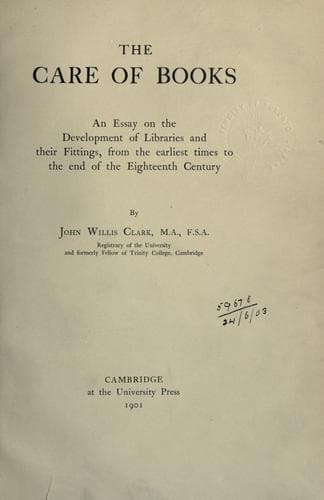
Libraries -- History; Library architecture -- History; Library fittings and supplies -- History
To this development of study in all directions the sixteenth century
offers a sad and startling contrast. In France the Huguenot movement took
the form of a bitter hostility to the clergy--which, after the fashion of
that day, exhibited itself in a very general destruction of churches,
monasteries, and their contents; while England witnessed the suppression
of the Monastic Orders, and the annihilation, so far as was practicable,
of all that belonged to them. I have shewn that monastic libraries were
the public libraries of the Middle Ages; more than this, the larger
houses were centres of culture and education, maintaining schools for
children, and sending older students to the Universities. In three years,
between 1536 and 1539. the whole system was swept away, as thoroughly as
though it had never existed. The buildings were pulled down, and the
materials sold; the plate was melted; and the books were either burnt, or
put to the vilest uses to which waste literature can be subjected. I will
state the case in another way which will bring out more clearly the result
of this catastrophe. Upwards of eight hundred monasteries were suppressed,
and, as a consequence, eight hundred libraries were done away with,
varying in size and importance from Christ Church, Canterbury, with its
2000 volumes, to small houses with little more than the necessary
service-books. By the year 1540 the only libraries left in England were
those at the two Universities, and in the Cathedrals of the old
foundation. Further, the royal commissioners made no attempt to save any
of the books with which the monasteries were filled. In France in 1789 the
revolutionary leaders sent the libraries of the convents they pillaged to
the nearest town: for instance, that of Citeaux to Dijon; of Clairvaux to
Troyes; of Corbie to Amiens. But in England at the suppression no such
precautions were taken; manuscripts seem to have been at a discount just
then, for which the invention of printing may be to some extent
responsible; their mercantile value was small; private collectors were
few. So the monastic libraries perished, save a few hundred manuscripts
which have survived to give us an imperfect notion of what the rest were
like.
How great the loss was, has probably been recorded by more than one
writer; but for the moment I can think of nothing more graphic than the
words of that bitter protestant John Bale, a contemporary who had seen the
old libraries, and knew their value. After lamenting that "in turnynge
ouer of y^e superstycyouse monasteryes so lytle respect was had to theyr
lybraryes for the sauegarde of those noble and precyouse monumentes" (the
works of ancient writers), he states what ought to have been done, and
what really happened.
Neuer had we bene offended for the losse of our
lybraryes beynge so many in nombre and in so desolate
places for the most parte, yf the chiefe monumentes and
moste notable workes of our excellent wryters had bene
reserued.
Public-domain text, read in full here on John Shaqi.
Reviews
Reviews
No reviews yet
Be the first to share your thoughts on this work.
Elsewhere in the archive
Join the Discussion
Join the discussion
Sign in to leave a comment or review.
Sign InorCreate an account