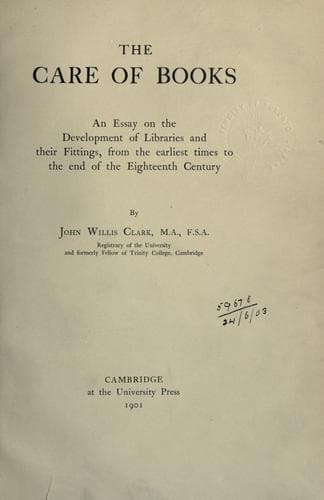
Libraries -- History; Library architecture -- History; Library fittings and supplies -- History
Books which are to be kept at hand for daily use,
whether for singing or reading, ought to be in some
common place, to which all the brethren can have easy
access for inspection, and selection of anything which
seems to them suitable. The books, therefore, ought not
to be carried away into chambers, or into corners
outside the Cloister or the Church. The Librarian ought
frequently to dust the books carefully, to repair them,
and to point them, lest brethren should find any error
or hindrance in the daily service of the church, whether
in singing or in reading. No other brother ought to
erase or change anything in the books unless he have
obtained the consent of the Librarian....
The press in which the books are kept ought to be lined
inside with wood, that the damp of the walls may not
moisten or stain the books. This press should be divided
vertically as well as horizontally by sundry shelves on
which the books may be ranged so as to be separated from
one another; for fear they be packed so close as to
injure each other or delay those who want them[141].
Further, as the books ought to be mended, pointed, and
taken care of by the Librarian, so ought they to be
properly bound by him.
The Order of Premontre--better known as the Premonstratensians, or
reformed Augustinians--repeat the essential part of these directions in
their statute, _Of the Librarian (armarius)_, with this addition, that it
is to be part of the librarian's duty to provide for the borrowing of
books for the use of the House, as well as for lending[142].
Lastly, the Friars, though property was forbidden, and S. Francis would
not allow his disciples to own so much as a psalter or a breviary[143],
soon found that books were a necessity, and the severity of early
discipline was relaxed in favour of a library. S. Francis died in 1226,
and only thirty-four years afterwards, among the constitutions adopted by
a General Chapter of the Order held at Narbonne 10 June, 1260, are several
provisions relating to books. They are of no great importance, taken by
themselves, but their appearance at so early a date proves that books had
become indispensable. It is enacted that no brother may write books, or
have them written, for sale; nor may the chief officer of a province
venture to keep books without leave obtained from the chief officer of the
whole Order; no brother may keep the books assigned to him, unless they
are altogether the property of the Order--and so forth[144]. A century
later, when Richard de Bury, Bishop of Durham, was writing his
_Philobiblon_ (completed 24 January, 1344-45), he could say of them and
the other friars--whom, be it remembered, he, as a regular, would regard
with scant favour--
Public-domain text, read in full here on John Shaqi.
Reviews
Reviews
No reviews yet
Be the first to share your thoughts on this work.
Elsewhere in the archive
Join the Discussion
Join the discussion
Sign in to leave a comment or review.
Sign InorCreate an account