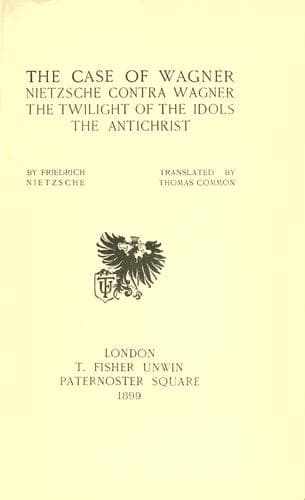
The Case of Wagner, Nietzsche Contra Wagner, and Selected Aphorisms.Nietzsche, Friedrich Wilhelm
PhilosophyPhilosophy
The Case of Wagner, Nietzsche Contra Wagner, and Selected Aphorisms.
Nietzsche, Friedrich Wilhelm
Essays; Literature -- Collections; Music -- History and criticism; Wagner, Richard, 1813-1883
—But you will not listen to me? You _prefer_ even the _problem_ of Wagner
to that of Bizet? But neither do I underrate it; it has its charm. The
problem of salvation is even a venerable problem. Wagner pondered over
nothing so deeply as over salvation: his opera is the opera of salvation.
Someone always wants to be saved in his operas,—now it is a youth; anon it
is a maid,—this is _his problem_—And how lavishly he varies his
_leitmotif_! What rare and melancholy modulations! If it were not for
Wagner, who would teach us that innocence has a preference for saving
interesting sinners? (the case in “Tannhauser”). Or that even the eternal
Jew gets saved and _settled down_ when he marries? (the case in the
“Flying Dutchman”). Or that corrupted old females prefer to be saved by
chaste young men? (the case of Kundry). Or that young hysterics like to be
saved by their doctor? (the case in “Lohengrin”). Or that beautiful girls
most love to be saved by a knight who also happens to be a Wagnerite? (the
case in the “Mastersingers”). Or that even married women also like to be
saved by a knight? (the case of Isolde). Or that the venerable Almighty,
after having compromised himself morally in all manner of ways, is at last
delivered by a free spirit and an immoralist? (the case in the “Ring”).
Admire, more especially this last piece of wisdom! Do you understand it?
I—take good care not to understand it.… That it is possible to draw yet
other lessons from the works above mentioned,—I am much more ready to
prove than to dispute. That one may be driven by a Wagnerian ballet to
desperation—_and_ to virtue! (once again the case in “Tannhauser”). That
not going to bed at the right time may be followed by the worst
consequences (once again the case of “Lohengrin”).—That one can never be
too sure of the spouse one actually marries (for the third time, the case
of “Lohengrin”). “Tristan and Isolde” glorifies the perfect husband who,
in a certain case, can ask only one question: “But why have ye not told me
this before? Nothing could be simpler than that!” Reply:
“That I cannot tell thee.
And what thou askest,
That wilt thou never learn.”
Public-domain text, read in full here on John Shaqi.
Reviews
Reviews
No reviews yet
Be the first to share your thoughts on this work.
Join the Discussion
Join the discussion
Sign in to leave a comment or review.
Sign InorCreate an account