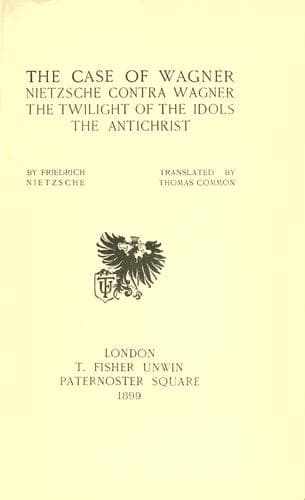
The Case of Wagner, Nietzsche Contra Wagner, and Selected Aphorisms.Nietzsche, Friedrich Wilhelm
PhilosophyPhilosophy
The Case of Wagner, Nietzsche Contra Wagner, and Selected Aphorisms.
Nietzsche, Friedrich Wilhelm
Essays; Literature -- Collections; Music -- History and criticism; Wagner, Richard, 1813-1883
both are conceivable only in a certain way, and so that each may give the
impression of freedom (the principle of the smallest expenditure of
energy). Now the very last thing that Wagner does is to sweat blood over
the plot; and on this and the unravelment he certainly spends the smallest
possible amount of energy. Let anybody put one of Wagner’s “plots” under
the microscope, and I wager that he will be forced to laugh. Nothing is
more enlivening than the dilemma in “Tristan,” unless it be that in the
“Mastersingers.” Wagner is _no_ dramatist; let nobody be deceived on this
point. All he did was to love the word “drama”—he always loved fine words.
Nevertheless, in his writings the word “drama” is merely a
misunderstanding (—_and_ a piece of shrewdness: Wagner always affected
superiority in regard to the word “opera”—), just as the word “spirit” is
a misunderstanding in the New Testament.—He was not enough of a
psychologist for drama; he instinctively avoided a psychological plot—but
how?—by always putting idiosyncrasy in its place.… Very modern—eh? Very
Parisian! very decadent!… Incidentally, the _plots_ that Wagner knows how
to unravel with the help of dramatic inventions, are of quite another
kind. For example, let us suppose that Wagner requires a female voice. A
whole act without a woman’s voice would be impossible! But in this
particular instance not one of the heroines happens to be free. What does
Wagner do? He emancipates the oldest woman on earth, Erda. “Step up, aged
grandmamma! You have got to sing!” And Erda sings. Wagner’s end has been
achieved. Thereupon he immediately dismisses the old lady. “Why on earth
did you come? Off with you! Kindly go to sleep again!” In short, a scene
full of mythological awe, before which the Wagnerite _wonders_ all kinds
of things.…
Public-domain text, read in full here on John Shaqi.
Reviews
Reviews
No reviews yet
Be the first to share your thoughts on this work.
Join the Discussion
Join the discussion
Sign in to leave a comment or review.
Sign InorCreate an account