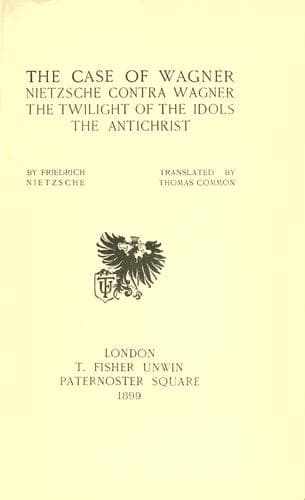
The Case of Wagner, Nietzsche Contra Wagner, and Selected Aphorisms. — John Shaqi
The Case of Wagner, Nietzsche Contra Wagner, and Selected Aphorisms.Nietzsche, Friedrich Wilhelm
PhilosophyPhilosophy
The Case of Wagner, Nietzsche Contra Wagner, and Selected Aphorisms.
Nietzsche, Friedrich Wilhelm
Essays; Literature -- Collections; Music -- History and criticism; Wagner, Richard, 1813-1883
In a word: “Wagner and Liszt.” Never yet have the “uprightness” and
“genuineness” of musicians been put to such a dangerous test. It is
glaringly obvious: great success, mob success is no longer the achievement
of the genuine,—in order to get it a man must be an actor!—Victor Hugo and
Richard Wagner—they both prove one and the same thing: that in declining
civilisations, wherever the mob is allowed to decide, genuineness becomes
superfluous, prejudicial, unfavourable. The actor, alone, can still kindle
_great_ enthusiasm.—And thus it is his _golden age_ which is now
dawning,—his and that of all those who are in any way related to him. With
drums and fifes, Wagner marches at the head of all artists in declamation,
in display and virtuosity. He began by convincing the conductors of
orchestras, the scene-shifters and stage-singers, not to forget the
orchestra:—he “delivered” them from monotony.… The movement that Wagner
created has spread even to the land of knowledge: whole sciences
pertaining to music are rising slowly, out of centuries of scholasticism.
As an example of what I mean, let me point more particularly to
_Riemann’s_ services to rhythmics; he was the first who called attention
to the leading idea in punctuation—even for music (unfortunately he did so
with a bad word; he called it “phrasing”).—All these people, and I say it
with gratitude, are the best, the most respectable among Wagner’s
admirers—they have a perfect right to honour Wagner. The same instinct
unites them with one another; in him they recognise their highest type,
and since he has inflamed them with his own ardour they feel themselves
transformed into power, even into great power. In this quarter, if
anywhere, Wagner’s influence has really been _beneficent_. Never before
has there been so much thinking, willing, and industry in this sphere.
Wagner endowed all these artists with a new conscience: what they now
exact and _obtain_ from themselves, they had never exacted before Wagner’s
time—before then they had been too modest. Another spirit prevails on the
stage since Wagner rules there the most difficult things are expected,
blame is severe, praise very scarce,—the good and the excellent have
become the rule. Taste is no longer necessary, nor even is a good voice.
Wagner is sung only with ruined voices: this has a more “dramatic” effect.
Even talent is out of the question. Expressiveness at all costs, which is
what the Wagnerian ideal—the ideal of decadence—demands, is hardly
compatible with talent. All that is required for this is virtue—that is to
say, training, automatism, “self-denial”. Neither taste, voices, nor
gifts, Wagner’s stage requires but one thing: _Germans!_… The definition
of a German: an obedient man with long legs.… There is a deep significance
in the fact that the rise of Wagner should have coincided with the rise of
the “Empire”: both phenomena are a proof of one and the same
thing—obedience and long legs.—Never have people been more obedient, never
Public-domain text, read in full here on John Shaqi.
Reviews
Reviews
No reviews yet
Be the first to share your thoughts on this work.
Join the Discussion
Join the discussion
Sign in to leave a comment or review.
Sign InorCreate an account