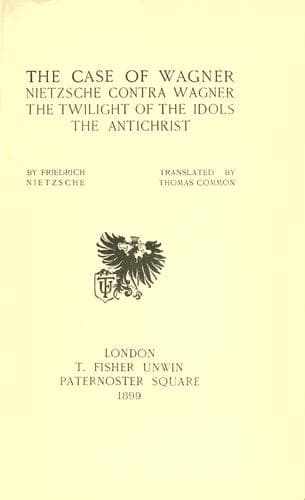
The Case of Wagner, Nietzsche Contra Wagner, and Selected Aphorisms.Nietzsche, Friedrich Wilhelm
PhilosophyPhilosophy
The Case of Wagner, Nietzsche Contra Wagner, and Selected Aphorisms.
Nietzsche, Friedrich Wilhelm
Essays; Literature -- Collections; Music -- History and criticism; Wagner, Richard, 1813-1883
In spite of the adverse criticism with which the above preface has met at
the hands of many reviewers since the summer of last year, I cannot say
that I should feel justified, even after mature consideration, in altering
a single word or sentence it contains. If I felt inclined to make any
changes at all, these would take the form of extensive additions, tending
to confirm rather than to modify the general argument it advances; but,
any omissions of which I may have been guilty in the first place, have
been so fully rectified since, thanks to the publication of the English
translations of Daniel Halévy’s and Henri Lichtenberger’s works, “The Life
of Friedrich Nietzsche,”(2) and “The Gospel of Superman,”(3) respectively,
that, were it not for the fact that the truth about this matter cannot be
repeated too often, I should have refrained altogether from including any
fresh remarks of my own in this Third Edition.
In the works just referred to (pp. 129 _et seq._ in Halévy’s book, and pp.
78 _et seq._ in Lichtenberger’s book), the statement I made in my preface
to “Thoughts out of Season,” vol. i., and which I did not think it
necessary to repeat in my first preface to these pamphlets, will be found
to receive the fullest confirmation.
The statement in question was to the effect that many long years before
these pamphlets were even projected, Nietzsche’s apparent _volte-face_ in
regard to his hero Wagner had been not only foreshadowed but actually
stated in plain words, in two works written during his friendship with
Wagner,—the works referred to being “The Birth of Tragedy” (1872), and
“Wagner in Bayreuth” (1875) of which Houston Stuart Chamberlain declares
not only that it possesses “undying classical worth” but that “a perusal
of it is indispensable to all who wish to follow the question [of Wagner]
to its roots.”(4)
The idea that runs through the present work like a leitmotif—the idea that
Wagner was at bottom more of a mime than a musician—was so far an ever
present thought with Nietzsche that it is ever impossible to ascertain the
period when it was first formulated.
In Nietzsche’s wonderful autobiography (_Ecce Homo_, p. 88), in the
section dealing with the early works just mentioned, we find the following
passage—“In the second of the two essays [Wagner in Bayreuth] with a
profound certainty of instinct, I already characterised the elementary
factor in Wagner’s nature as a theatrical talent which, in all his means
and aspirations, draws its final conclusions.” And as early as 1874,
Nietzsche wrote in his diary—“Wagner is a born actor. Just as Goethe was
an abortive painter, and Schiller an abortive orator, so Wagner was an
abortive theatrical genius. His attitude to music is that of the actor;
for he knows how to sing and speak, as it were out of different souls and
from absolutely different worlds (_Tristan_ and the _Meistersinger_).”
Public-domain text, read in full here on John Shaqi.
Reviews
Reviews
No reviews yet
Be the first to share your thoughts on this work.
Join the Discussion
Join the discussion
Sign in to leave a comment or review.
Sign InorCreate an account