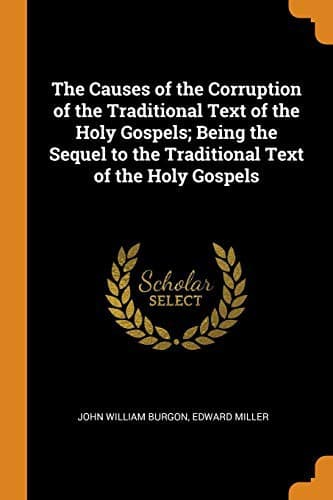
The Causes of the Corruption of the Traditional Text of the Holy Gospels: Being the Sequel to The Traditional Text of the Holy GospelsBurgon, John William
Religion
The Causes of the Corruption of the Traditional Text of the Holy Gospels: Being the Sequel to The Traditional Text of the Holy Gospels
Burgon, John William
Bible. Gospels -- Criticism, Textual
Almost as reasonably in the beginning of the same verse might
Tischendorf (with [Symbol: Aleph]) have substituted [Greek:
anadeiknynai] for [Greek: hina poiesosin auton], on the plea that
Cyril[381] says, [Greek: zetein auton anadeixai kai basilea]. We may on
no account suffer ourselves to be imposed upon by such shallow pretences
for tampering with the text of Scripture: or the deposit will never be
safe. A patent gloss,--rather an interpretation,--acquires no claim to
be regarded as the genuine utterance of the Holy Spirit by being merely
found in two or three ancient documents. It is the little handful of
documents which loses in reputation,--not the reading which gains in
authority on such occasions.
In this way we are sometimes presented with what in effect are new
incidents. These are not unfrequently discovered to be introduced in
defiance of the reason of the case; as where (St. John xiii. 34) Simon
Peter is represented (in the Vulgate) as _actually saying_ to St. John,
'Who is it concerning whom He speaks?' Other copies of the Latin
exhibit, 'Ask Him who it is,' &c.: while [Symbol: Aleph]BC (for on such
occasions we are treated to any amount of apocryphal matter) would
persuade us that St. Peter only required that the information should be
furnished him by St. John:--'Say who it is of whom He speaks.' Sometimes
a very little licence is sufficient to convert the _oratio obliqua_ into
the recta. Thus, by the change of a single letter (in [Symbol: Aleph]BX)
Mary Magdalene is made to say to the disciples 'I have seen the Lord'
(St. John xx. 18). But then, as might have been anticipated, the new
does not altogether agree with the old. Accordingly D and others
paraphrase the remainder of the sentence thus,--'and she signified to
them what He had said unto her.' How obvious is it to foresee that on
such occasions the spirit of officiousness will never know when to stop!
In the Vulgate and Sahidic versions the sentence proceeds, 'and He told
these things unto me.'
Public-domain text, read in full here on John Shaqi.
Reviews
Reviews
No reviews yet
Be the first to share your thoughts on this work.
Elsewhere in the archive
Join the Discussion
Join the discussion
Sign in to leave a comment or review.
Sign InorCreate an account