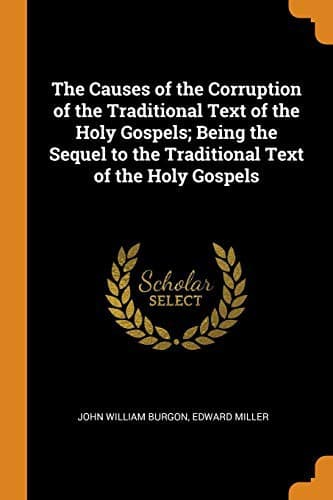
The Causes of the Corruption of the Traditional Text of the Holy Gospels: Being the Sequel to The Traditional Text of the Holy GospelsBurgon, John William
Religion
The Causes of the Corruption of the Traditional Text of the Holy Gospels: Being the Sequel to The Traditional Text of the Holy Gospels
Burgon, John William
Bible. Gospels -- Criticism, Textual
Take another example. The Hebraism [Greek: meta salpingos phones
megales] (St. Matt. xxiv. 31) presents an uncongenial ambiguity to
Western readers, as our own incorrect A. V. sufficiently shews. Two
methods of escape from the difficulty suggested themselves to the
ancients:--(_a_) Since 'a trumpet of great sound' means nothing else but
'a loud trumpet,' and since this can be as well expressed by [Greek:
salpingos megales], the scribes at a very remote period are found to
have omitted the word [Greek: phones]. The Peshitto and Lewis
(interpreting rather than translating) so deal with the text.
Accordingly, [Greek: phones] is not found in [Symbol: Aleph]L[Symbol:
Delta] and five cursives. Eusebius[382], Cyril Jerus.[383],
Chrysostom[384], Theodoret[385], and even Cyprian[386] are also without
the word. (_b_) A less violent expedient was to interpolate [Greek: kai]
before [Greek: phones]. This is accordingly the reading of the best
Italic copies, of the Vulgate, and of D. So Hilary[387] and Jerome[388],
Severianus[389], Asterius[390], ps.-Caesarius[391], Damascene[392] and
at least eleven cursive copies, so read the place.--There can be no
doubt at all that the commonly received text is right. It is found in
thirteen uncials with B at their head: in Cosmas[393], Hesychius[394],
Theophylact[395]. But the decisive consideration is that the great body
of the cursives have faithfully retained the uncongenial Hebraism, and
accordingly imply the transmission of it all down the ages: a phenomenon
which will not escape the unprejudiced reader. Neither will he overlook
the fact that the three 'old uncials' (for A and C are not available
here) advocate as many different readings: the two wrong readings being
respectively countenanced by our two most ancient authorities, viz. the
Peshitto version and the Italic. It only remains to point out that
Tischendorf blinded by his partiality for [Symbol: Aleph] contends here
for the mutilated text, and Westcott and Hort are disposed to do the
same.
Sec. 4.
Public-domain text, read in full here on John Shaqi.
Reviews
Reviews
No reviews yet
Be the first to share your thoughts on this work.
Elsewhere in the archive
Join the Discussion
Join the discussion
Sign in to leave a comment or review.
Sign InorCreate an account