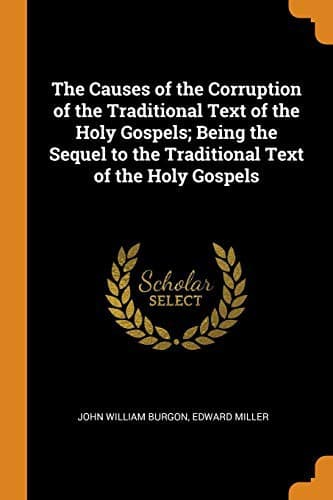
The Causes of the Corruption of the Traditional Text of the Holy Gospels: Being the Sequel to The Traditional Text of the Holy GospelsBurgon, John William
Religion
The Causes of the Corruption of the Traditional Text of the Holy Gospels: Being the Sequel to The Traditional Text of the Holy Gospels
Burgon, John William
Bible. Gospels -- Criticism, Textual
But in the meantime, Valentinus, whose example was followed by Theodotus
and by at least two of the Gnostic sects against whom Hippolytus wrote,
had gone further. The better to conceal St. John's purpose, the
heresiarch falsified the inspired text. In the place of, 'What was made
in Him, was life,' he substituted 'What was made in Him, _is_ life.'
Origen had seen copies so depraved, and judged the reading not
altogether improbable. Clement, on a single occasion, even adopted it.
It was the approved reading of the Old Latin versions,--a memorable
indication, by the way, of a quarter from which the Old Latin derived
their texts,--which explains why it is found in Cyprian, Hilary, and
Augustine; and why Ambrose has so elaborately vindicated its
sufficiency. It also appears in the Sahidic and in Cureton's Syriac; but
not in the Peshitto, nor in the Vulgate. [Nor in the Bohairic] In the
meantime, the only Greek Codexes which retain this singular trace of the
Gnostic period at the present day, are Codexes [Symbol: Aleph] and D.
Sec. 4.
[We may now take some more instances to shew the effects of the
operations of Heretics.]
The good Shepherd in a certain place (St. John x. 14, 15) says
concerning Himself--'I know My sheep and am known of Mine, even as the
Father knoweth Me and I know the Father': by which words He hints at a
mysterious knowledge as subsisting between Himself and those that are
His. And yet it is worth observing that whereas He describes the
knowledge which subsists between the Father and the Son in language
which implies that it is strictly identical on either side, He is
careful to distinguish between the knowledge which subsists between the
creature and the Creator by slightly varying the expression,--thus
leaving it to be inferred that it is not, neither indeed can be, on
either side the same. God knoweth us with a perfect knowledge. Our
so-called 'knowledge' of God is a thing different not only in degree,
but in kind[478]. Hence the peculiar form which the sentence
assumes[479]:--[Greek: ginosko ta ema, kai ginoskomai hypo ton emon].
And this delicate diversity of phrase has been faithfully retained all
down the ages, being witnessed to at this hour by every MS. in existence
except four now well known to us: viz. [Symbol: Aleph]BDL. The Syriac
also retains it,--as does Macarius[480], Gregory Naz.[481],
Chrysostom[482], Cyril[483], Theodoret[484], Maximus[485]. It is a point
which really admits of no rational doubt: for does any one suppose that
if St. John had written 'Mine own know Me,' 996 MSS. out of 1000 at the
end of 1,800 years would exhibit, 'I am known of Mine'?
Public-domain text, read in full here on John Shaqi.
Reviews
Reviews
No reviews yet
Be the first to share your thoughts on this work.
Elsewhere in the archive
Join the Discussion
Join the discussion
Sign in to leave a comment or review.
Sign InorCreate an account