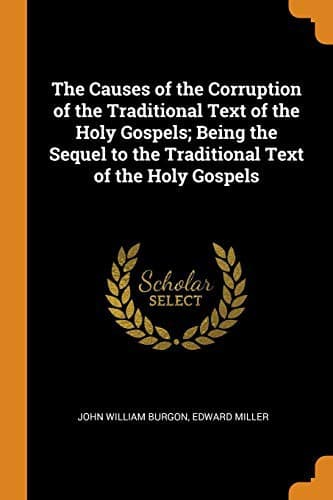
The Causes of the Corruption of the Traditional Text of the Holy Gospels: Being the Sequel to The Traditional Text of the Holy GospelsBurgon, John William
Religion
The Causes of the Corruption of the Traditional Text of the Holy Gospels: Being the Sequel to The Traditional Text of the Holy Gospels
Burgon, John William
Bible. Gospels -- Criticism, Textual
We are not surprised after this to find that those places in the Gospel
which bear on the relation between man and wife exhibit traces of
perturbation. I am not asserting that the heretics themselves depraved
the text. I do but state two plain facts: viz. (1) That whereas in the
second century certain heretical tenets on the subject of Marriage
prevailed largely, and those who advocated as well as those who opposed
such teaching relied chiefly on the Gospel for their proofs: (2) It is
accordingly found that not only does the phenomenon of 'various
readings' prevail in those places of the Gospel which bear most nearly
on the disputed points, but the 'readings' are exactly of that
suspicious kind which would naturally result from a tampering with the
text by men who had to maintain, or else to combat, opinions of a
certain class. I proceed to establish what I have been saying by some
actual examples[493].
St. Matt. xix. 29.
[Greek: e gynaika,]
--BD abc Orig.
St. Mark x. 29.
[Greek: e gynaika,]
--[Symbol: Aleph]BD[Symbol: Delta], abc, &c.
St. Luke xviii. 29.
[Greek: e gynaika],
all allow it.
[Greek: hotan de lege; hoti "pas hostis apheke gynaika," ou touto
phesin, hoste aplos diaspasthai tous gamous, k.t.l.] Chrys. vii. 636 E.
[Greek: Paradeigmatisai] (in St. Matt. i. 19) is another of the
expressions which have been disturbed by the same controversy. I suspect
that Origen is the author (see the heading of the Scholion in Cramer's
Catenae) of a certain uncritical note which Eusebius reproduces in his
'quaestiones ad Stephanum[494]' on the difference between [Greek:
deigmatisai] and [Greek: paradeigmatisai]; and that with him originated
the substitution of the uncompounded for the compounded verb in this
place. Be that as it may, Eusebius certainly read [Greek:
paradeigmatisai] (Dem. 320), with all the uncials but two (BZ): all the
cursives but one (I). Will it be believed that Lachmann, Tregelles,
Tischendorf, Alford, Westcott and Hort, on such slender evidence as that
are prepared to reconstruct the text of St. Matthew's Gospel?
Public-domain text, read in full here on John Shaqi.
Reviews
Reviews
No reviews yet
Be the first to share your thoughts on this work.
Elsewhere in the archive
Join the Discussion
Join the discussion
Sign in to leave a comment or review.
Sign InorCreate an account