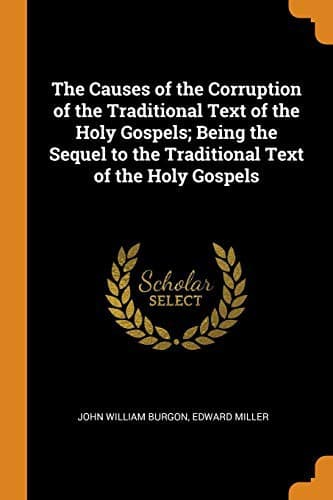
The Causes of the Corruption of the Traditional Text of the Holy Gospels: Being the Sequel to The Traditional Text of the Holy GospelsBurgon, John William
Religion
The Causes of the Corruption of the Traditional Text of the Holy Gospels: Being the Sequel to The Traditional Text of the Holy Gospels
Burgon, John William
Bible. Gospels -- Criticism, Textual
[452] 'Licet non sint digni fide, qui fidem primam irritam fecerunt,
Marcionem loquor et Basilidem et omnes Haereticos qui vetus laniant
Testamentum: tamen eos aliqua ex parte ferremus, si saltem in novo
continerent manus suas; et non auderent Christi (ut ipsi iactitant) boni
Dei Filii, vel Evangelistas violare, vel Apostolos. Nunc vero, quum et
Evangelia eius dissipaverint; et Apostolorum epistolas, non Apostolorum
Christi fecerunt esse, sed proprias; miror quomodo sibi Christianorum
nomen audeant vindicare. Ut enim de caeteris Epistolis taceam, (de
quibus quidquid contrarium suo dogmati viderant, evaserunt, nonnullas
integras repudiandas crediderunt); ad Timotheum videlicet utramque, ad
Hebraeos, et ad Titum, quam nunc conamur exponere.' Hieron. Praef. ad
Titum.
[453] 'Hi vero, qui sunt a Valentino, exsistentes extra omnem timorem,
suas conscriptiones praeferentes, plura habere gloriantur, quam sint
ipsa Evangelia. Siquidem in tantum processerunt audaciae, uti quod ab
his non olim conscriptum est, Veritatis Evangelium titulent.' Iren. iii.
xi. 9.
[454] See, by all means, Epiphanius, Haer. xxx. c. xiii; also c. iii.
[455] 'Tanta est circa Evangelia haec firmitas, ut et ipsi haeretici
testimonium reddant eis, et ex ipsis egrediens unusquisque eorum conetur
suam confirmare doctrinam. Ebionaei etenim eo Evangelio quod est
secundum Matthaeum, solo utentes, ex illo ipso convincuntur, non recte
praesumentes de Domino. Marcion autem id quod est secundum Lucam
circumcidens, ex his quae adhuc servantur penes eum, blasphemus in solum
existentem Deum ostenditur. Qui autem Iesum separant a Christo, et
impassibilem perseverasse Christum, passum vero Iesum dicunt, id quod
secundum Marcum est praeferentes Evangelium; cum amore veritatis
legentes illud, corrigi possunt. Hi autem qui a Valentino sunt, eo quod
est secundum Joannem plenissime utentes,' &c. Iren. iii. xi. 7.
[456] [Greek: Herakleon, ho tes Oualentinou scholes dokimotatos]. Clem.
Al. p. 595. Of Heracleon it is expressly related by Origen that he
depraved the text of the Gospel. Origen says (iv. 66) that Heracleon
(regardless of the warning in Prov. xxx. 6) added to the text of St.
John i. 3 (vii. after the words [Greek: egeneto oude en]) the words
[Greek: ton en to kosmoi, kai te ktisei]. Heracleon clearly read [Greek:
ho gegonen en auto zoe en]. See Orig. iv. 64. In St. John ii. 19, for
[Greek: en trisi], he wrote [Greek: en trite]. He also read (St. John
iv. 18) (for [Greek: pente]), [Greek: ex andras esches].
[457] Celsus having objected that believers had again and again
falsified the text of the Gospel, refashioning it, in order to meet the
objections of assailants, Origen replies: [Greek: Metacharaxantas de to
euangelion allous ouk oida, he tous apo Markionos, kai tous apo
Oualentinou, oimai de kai tous apo Loukanou. touto de legomenon ou tou
logou estin egklema, alla ton tolmesanton rhadiourgesai ta euangelia].
Opp. i. 411 B.
[458] De Praesc. Haer. c. 51.
Public-domain text, read in full here on John Shaqi.
Reviews
Reviews
No reviews yet
Be the first to share your thoughts on this work.
Elsewhere in the archive
Join the Discussion
Join the discussion
Sign in to leave a comment or review.
Sign InorCreate an account