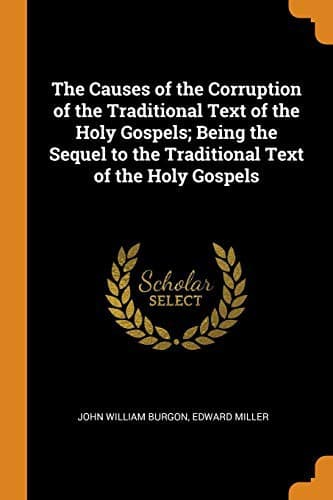
The Causes of the Corruption of the Traditional Text of the Holy Gospels: Being the Sequel to The Traditional Text of the Holy GospelsBurgon, John William
Religion
The Causes of the Corruption of the Traditional Text of the Holy Gospels: Being the Sequel to The Traditional Text of the Holy Gospels
Burgon, John William
Bible. Gospels -- Criticism, Textual
While [Symbol: Aleph] and B are alone in refusing to recognize either
first, second or third clause. And this is a fair sample of that
'singular agreement' which is sometimes said to subsist between 'the
lesser group of witnesses.' Is it not plain on the contrary that at a
very remote period there existed a fierce conflict, and consequent
hopeless divergence of testimony about the present passage; of which
1,700 years[571] have failed to obliterate the traces? Had [Symbol:
Aleph]B been our only ancient guides, it might of course have been
contended that there has been no act of spoliation committed: but seeing
that one half of the missing treasure is found with their allies, ACD,
Clement Alex., Chrysostom, Cyril, Jerome,--the other half with their
allies, Old Latin, Harkleian, Clement, Tertullian, Cyprian, Ambrose,
Didymus, Epiphanius, Chrysostom, Cyril, Theodoret, Jerome,
Augustine[572],--it is clear that no such pretence can any longer be set
up.
The endeavour to establish agreement among the witnesses by a skilful
distribution or rather dislocation of their evidence, a favourite device
with the Critics, involves a fallacy which in any other subject would be
denied a place. I trust that henceforth St. Luke ix. 54-6 will be left
in undisputed possession of its place in the sacred Text,--to which it
has an undoubted right.
A thoughtful person may still inquire, Can it however be explained
further how it has come to pass that the evidence for omitting the first
clause and the two last is so unequally divided? I answer, the disparity
is due to the influence of the Lectionaries.
Let it be observed then that an ancient Ecclesiastical Lection which
used to begin either at St. Luke ix. 44, or else at verse 49 and to
extend down to the end of verse 56[573], ended thus,--[Greek: hos kai
Elias epoiese; strapheis de epetimesen autois. kai eporeuthesan eis
hetepan komen][574]. It was the Lection for Thursday in the fifth week
of the new year; and as the reader sees, it omitted the two last clauses
exactly as Codd. [Symbol: Aleph]ABC do. Another Ecclesiastical Lection
began at verse 51 and extended down to verse 57, and is found to have
contained the two last clauses[575]. I wish therefore to inquire:--May
it not fairly be presumed that it is the Lectionary practice of the
primitive age which has led to the irregularity in this perturbation of
the sacred Text?
FOOTNOTES:
[495] [Greek: Pros tois dokesei ton Christon pephenenai legontas].
[496] [Greek: To de paidion euxane, kai ekrataiouto pneumati].
[497] It is the twenty-fourth and the thirtieth question in the first
Dialogus of pseudo-Caesarius (Gall. vi. 17, 20).
[498] Opp. iii. 953, 954,--with suspicious emphasis.
[499] Ed. Migne, vol. 93, p. 1581 a, b (Novum Auct. i. 700).
Public-domain text, read in full here on John Shaqi.
Reviews
Reviews
No reviews yet
Be the first to share your thoughts on this work.
Elsewhere in the archive
Join the Discussion
Join the discussion
Sign in to leave a comment or review.
Sign InorCreate an account