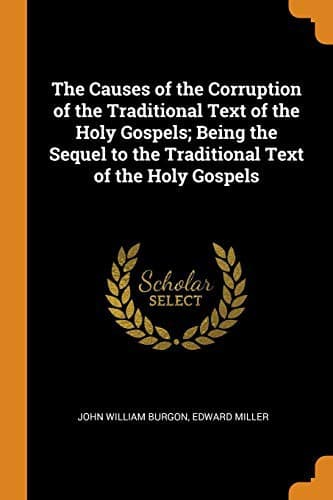
The Causes of the Corruption of the Traditional Text of the Holy Gospels: Being the Sequel to The Traditional Text of the Holy GospelsBurgon, John William
Religion
The Causes of the Corruption of the Traditional Text of the Holy Gospels: Being the Sequel to The Traditional Text of the Holy Gospels
Burgon, John William
Bible. Gospels -- Criticism, Textual
[500] When Cyril writes (Scholia, ed. Pusey, vol. vi. 568),--"[Greek: To
de paidion euxane kai ekrataiouto PNEUMATI, pleroumenon SOPHIA kai
CHARITI." kaitoi kata physin panteleios estin hos Theos kai ex idion
pleromatos dianemei tois agiois ta PNEUMATIKA, kai autos estin e SOPHIA,
kai tes CHARITOS ho doter],--it is clear that [Greek: pneumati] must
have stood in Cyril's text. The same is the reading of Cyril's Treatise,
De Incarnatione (Mai, ii. 57): and of his Commentary on St. Luke (ibid.
p. 136). One is surprised at Tischendorf's perverse inference concerning
the last-named place. Cyril had begun by quoting the whole of ver. 40 in
exact conformity with the traditional text (Mai, ii. 136). At the close
of some remarks (found both in Mai and in Cramer's Catena), Cyril
proceeds as follows, according to the latter:--[Greek: ho Euangelistes
epse "euxane kai ekrataiouto" KAI TA EXES]. Surely this constitutes no
ground for supposing that he did not recognize the word [Greek:
pneumati], but rather that he did. On the other hand, it is undeniable
that in V. P. ii. 138 and 139 (= Concilia iii. 241 d, 244 a), from
Pusey's account of what he found in the MSS. (vii. P. i. 277-8), the
word [Greek: pneumati] must be suspected of being an unauthorized
addition to the text of Cyril's treatise, De Recta fide ad Pulcheriam et
Eudociam.
[501] ii. 152: iv. 112: v. 120, 121 (four times).
[502] [Greek: Ei teleios esti Theos ho Christos, pos ho euangelistes
legei, to de paidion Iesous euxane kai ekrataiouto pneumati];--S.
Caesarii, Dialogus I, Quaest. 24 (_ap._ Galland. vi. 17 c). And see
Quaest. 30.
[503] ii. 36 d.
[504] Fragmenta Syriaca, ed. Sachau, p. 53.--The only other Greek
Fathers who quote the place are Euthymius and Theophylact.
[505] [Greek: Hen ekousa para tou Theou]. Epiph. i. 463.
[506] Instead of [Greek: para tou Theou].
[507] i. 410: iv. 294, 534. Elsewhere he defends and employs it.
[508] i. 260, 463: ii. 49.
[509] i. 705.
[510] viii. 365.
[511] (Glaph.) i. 18.
[512] iv. 83, 430. But both Origen (i. 705: iv. 320, 402) and Cyril (iv.
554: v. 758) quote the traditional reading; and Cyril (iv. 549)
distinctly says that the latter is right, and [Greek: para tou patros]
wrong.
[513] Excerpt. Theod. 968.--Heracleon's name is also connected by Origen
with this text. Valentinus (ap. Iren. 100) says, [Greek: on de kai uion
Monogene kai Theon kekleken].
[514] Pp. 627, 630, 466.
[515] P. 956.
Public-domain text, read in full here on John Shaqi.
Reviews
Reviews
No reviews yet
Be the first to share your thoughts on this work.
Elsewhere in the archive
Join the Discussion
Join the discussion
Sign in to leave a comment or review.
Sign InorCreate an account