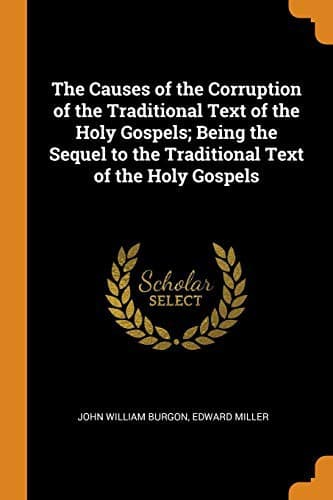
The Causes of the Corruption of the Traditional Text of the Holy Gospels: Being the Sequel to The Traditional Text of the Holy GospelsBurgon, John William
Religion
The Causes of the Corruption of the Traditional Text of the Holy Gospels: Being the Sequel to The Traditional Text of the Holy Gospels
Burgon, John William
Bible. Gospels -- Criticism, Textual
Addas Adimantus (a disciple of Manes) was the author of a work of the
same kind. Augustine (viii. 606 c) says of it,--'ubi de utroque
Testamento velut inter se contraria testimonia proferuntur versipelli
dolositate, velut inde ostendatur utrumque ab uno Deo esse non posse,
sed alterum ab altero.' Cerdon was the first to promulgate this
pestilential tenet (605 a). Then Marcion his pupil, then Apelles, and
then Patricius.
[569] Titus Bostr. adv. Manichaeos (_ap._ Galland. v. 329 b), leaving
others to note the correspondences between the New and the Old
Testament, proposes to handle the 'Contrasts': [Greek: pros autas tas
antitheseis ton logion choresomen]. At pp. 339 e, 340 a, b, he confirms
what Tertullian says about the calling down of fire from heaven.
[570] Verba [Greek: hos kai E. epoiese] cur quis addiderit, planum.
Eidem interpolatori debentur quae verba [Greek: str. de epeti. autois]
excipiunt. Gravissimum est quod testium additamentum [Greek: ho gar
huios], &c. ab eadem manu derivandum est, nec per se solum pro spurio
haberi potest; cohaeret enim cum argumento tum auctoritate arctissime
cum prioribus. (N. T. ed. 1869, p. 544.)
[571] Secundo iam saeculo quin in codicibus omnis haec interpolatio
circumferri consueverit, dubitari nequit. (Ibid.)
[572] The following are the references left by the Dean. I have not had
time or strength to search out those which are left unspecified in this
MS. and the last.
Jerome.--Apostoli in Lege versati ... ulcisci nituntur iniuriam, _et
imitari Eliam_, &c. Dominus, qui non ad iudicandum _venerat_, sed _ad
salvandum_, &c. ... increpat eos _quod non meminerint doctrinae suae et
bonitatis Evangelicae_, &c. (i. 857 b, c, d.)
Cyprian, Synodical Epistle.--'Filius hominis non venit animas hominum
perdere, sed salvare.' p. 98. A.D. 253.
Tatian.--Veni, inquit, animam salvam facere. (Carn. c. 12 et 10: and
Anim. c. 13.)
Augustine gives a long extract from the same letter and thus quotes the
words twice,--x. 76, 482. Cp. ii. 593 a.
[Greek: Kai ho Kyrios pros tous apostolous eipontas en pyri kolasai tous
me dexamenous autous kata ton Elian; Ouk oidate phesi poiou pneumatos
este]. (p. 1019.)
Theodoret, iii. 1119. ([Greek: poiou].)
Epiph. ii. 31. ([Greek: hoiou].)
Basil, ii. 271 (Eth.) quotes the whole place.
Augustine.--Respondit eis Dominus, dicens eos nescire cuius spiritus
filii essent, et quod ipse liberare venisset, non perdere. viii. 139 b.
Cp. iii. (2), 194 b.
Cyril Al.--[Greek: Mepo tes neas kekratekotes charitos ... touto eipon,
ton Elian aphorontes ton pyri k.t.l.] Cord. Cat. 263 = Cram. Cat. 81.
Also iv. 1017.--By a strange slip of memory, Cyril sets down a reproof
found in St. Matthew: but this is enough to shew that he admits that
_some_ reproof finds record in the Gospel.
Chrys. vii. 567 e: x. 305 d: vii. 346 a: ix. 677 c.
Opus Imp. ap. Chrys. vi. 211, 219.
Didymus.--[Greek: Ouk oidate oiou pneumatos estin ho huios tou
anthropou]. De Trin. p. 188.
Public-domain text, read in full here on John Shaqi.
Reviews
Reviews
No reviews yet
Be the first to share your thoughts on this work.
Elsewhere in the archive
Join the Discussion
Join the discussion
Sign in to leave a comment or review.
Sign InorCreate an account