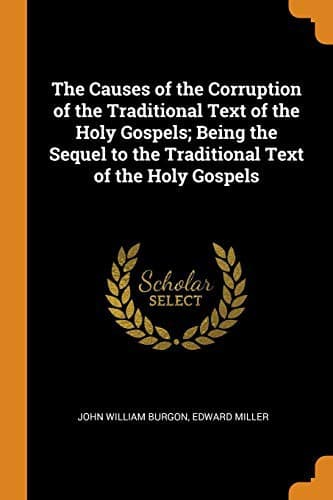
The Causes of the Corruption of the Traditional Text of the Holy Gospels: Being the Sequel to The Traditional Text of the Holy GospelsBurgon, John William
Religion
The Causes of the Corruption of the Traditional Text of the Holy Gospels: Being the Sequel to The Traditional Text of the Holy Gospels
Burgon, John William
Bible. Gospels -- Criticism, Textual
[560] Vol. i. p. 1275,--[Greek: ho deuteros anthr. ho Kyrios ex ouranou
ouranios]:--on which he remarks, (if indeed it be he), [Greek: idou gar
amphoterothen ouranios anthropos onomazetai]. And lower down,--[Greek:
Kyrios, dia ten mian hypostasin; deut. men anthr., kata ten henomenen
anthropoteta. ex ouranou de, kata ten theoteta].--P. 448,--[Greek: ho
deuteros anthr. ex ouranou epouranios].--_Ap._ Montf. ii. 13 (= Galland.
v. 167),--[Greek: ho deut. anthr. ex ouranou].--Note that Maximinus, an
Arian bishop, A.D. 427-8 (_ap._ Augustin. viii. 663) is found to have
possessed a text identical with the first of the preceding:--'Ait ipse
Paulus, _Primus homo Adam de terra terrenus, secundus homo Dominus de
Caelo caelestis_ advenit.'
[561] See Revision Revised, pp. 132-5: and The Traditional Text, p. 114.
[562] This paper is marked as having been written at Chichester in 1877,
and is therefore earlier than the Dean's later series.
[563] Proleg. 418.
[564] The text of St. Luke ix. 51-6 prefixed to Cyril's fifty-sixth
Sermon (p. 353) is the text of B and [Symbol: Aleph],--an important
testimony to what I suppose may be regarded as the Alexandrine _Textus
Receptus_ of this place in the fifth century. But then no one supposes
that Cyril is individually responsible for the headings of his Sermons.
We therefore refer to the body of his discourse; and discover that the
Syriac translator has rendered it (as usual) with exceeding licence. He
has omitted to render some such words as the following which certainly
stood in the original text:--[Greek: eidenai gar chre, hoti hos mepo tes
neas kekratekotes charitos, all' eti tes proteras echomenoi synetheias,
touto eipon, pros Elian aphorontes ton pyri kataphlexanta dis tous
pentekonta kai tous egoumenous auton], (Cramer's Cat. ii. p. 81. Cf.
Corderii, Cat. p. 263. Also Matthaei. N. T. _in loc._, pp. 333-4.) Now
the man who wrote _that_, must surely have read St. Luke ix. 54, 55 as
we do.
[565] See the fragment (and Potter's note), Opp. p. 1019: also Galland.
ii. 157. First in Hippolyt., Opp. ed. Fabric, ii. 71.
[566] In St. Matt. xviii. 11, the words [Greek: zetesai kai] do not
occur.
[567] Bp. Kaye's Tertullian, p. 468. 'Agnosco iudicis severitatem. E
contrario Christi in eandem animadversionem destinantes discipulos super
ilium viculum Samaritarum.' Marc. iv. 23 (see ii. p. 221). He
adds,--'Let Marcion also confess that by the same terribly severe judge
Christ's leniency was foretold;' and he cites in proof Is. xlii. 2 and 1
Kings xix. 12 ('sed in _spiritu_ miti').
[568] Augustine (viii. 111-150, 151-182) writes a book against him. And
he discusses St. Luke ix. 54-5 on p. 139.
Public-domain text, read in full here on John Shaqi.
Reviews
Reviews
No reviews yet
Be the first to share your thoughts on this work.
Elsewhere in the archive
Join the Discussion
Join the discussion
Sign in to leave a comment or review.
Sign InorCreate an account