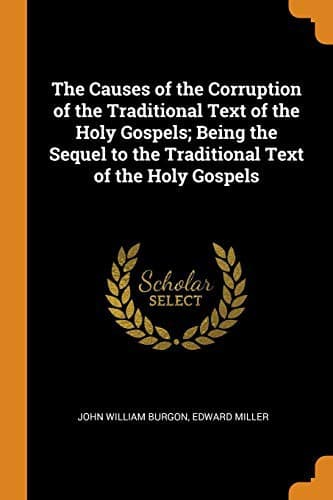
The Causes of the Corruption of the Traditional Text of the Holy Gospels: Being the Sequel to The Traditional Text of the Holy GospelsBurgon, John William
Religion
The Causes of the Corruption of the Traditional Text of the Holy Gospels: Being the Sequel to The Traditional Text of the Holy Gospels
Burgon, John William
Bible. Gospels -- Criticism, Textual
add, corrupt copy? The same Critics are reminded that in the same four
Codexes [commonly called the Ferrar Group] 'the agony and bloody sweat'
(St. Luke xxii. 43, 44) is found thrust into St. Matthew's Gospel
between ch. xxvi. 39 and 40. Such licentiousness on the part of a
solitary exemplar of the Gospels no more affects the proper place of
these or of those verses than the superfluous digits of a certain man of
Gath avail to disturb the induction that to either hand of a human being
appertain but five fingers, and to either foot but five toes.
It must be admitted then that as far back as testimony reaches the
passage under discussion stood where it now stands in St. John's Gospel.
And this is my first position. But indeed, to be candid, hardly any one
has seriously called that fact in question. No, nor do any (except Dr.
Hort[610]) doubt that the passage is also of the remotest antiquity.
Adverse Critics do but insist that however ancient, it must needs be of
spurious origin: or else that it is an afterthought of the
Evangelist:--concerning both which imaginations we shall have a few
words to offer by-and-by.
It clearly follows,--indeed it may be said with truth that it only
remains,--to inquire what may have led to its so frequent exclusion from
the sacred Text? For really the difficulty has already resolved itself
into that.
And on this head, it is idle to affect perplexity. In the earliest age
of all,--the age which was familiar with the universal decay of heathen
virtue, but which had not yet witnessed the power of the Gospel to
fashion society afresh, and to build up domestic life on a new and more
enduring basis;--at a time when the greatest laxity of morals prevailed,
and the enemies of the Gospel were known to be on the look out for
grounds of cavil against Christianity and its Author;--what wonder if
some were found to remove the _pericope de adultera_ from their copies,
lest it should be pleaded in extenuation of breaches of the seventh
commandment? The very subject-matter, I say, of St. John viii. 3-11
would sufficiently account for the occasional omission of those nine
verses. Moral considerations abundantly explain what is found to have
here and there happened. But in fact this is not a mere conjecture of my
own. It is the reason assigned by Augustine for the erasure of these
twelve verses from many copies of the Gospel[611]. Ambrose, a quarter of
a century earlier, had clearly intimated that danger was popularly
apprehended from this quarter[612]: while Nicon, five centuries later,
states plainly that the mischievous tendency of the narrative was the
cause why it had been expunged from the Armenian version[613].
Accordingly, just a few Greek copies are still to be found mutilated in
respect of those nine verses only. But in fact the indications are not a
few that all the twelve verses under discussion did not by any means
labour under the same degree of disrepute. The first three (as I shewed
Public-domain text, read in full here on John Shaqi.
Reviews
Reviews
No reviews yet
Be the first to share your thoughts on this work.
Elsewhere in the archive
Join the Discussion
Join the discussion
Sign in to leave a comment or review.
Sign InorCreate an account