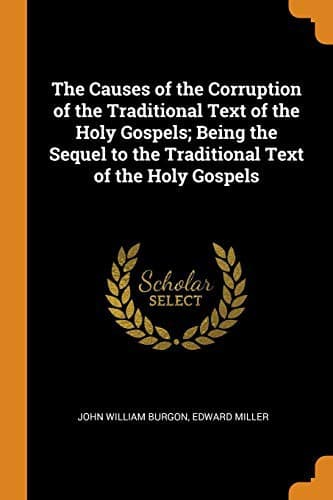
The Causes of the Corruption of the Traditional Text of the Holy Gospels: Being the Sequel to The Traditional Text of the Holy GospelsBurgon, John William
Religion
The Causes of the Corruption of the Traditional Text of the Holy Gospels: Being the Sequel to The Traditional Text of the Holy Gospels
Burgon, John William
Bible. Gospels -- Criticism, Textual
at the outset) clearly belong to a different category from the last
nine,--a circumstance which has been too much overlooked.
The Church in the meantime for an obvious reason had made choice of St.
John vii. 37-viii. 12--the greater part of which is clearly descriptive
of what happened at the Feast of Tabernacles--for her Pentecostal
lesson: and judged it expedient, besides omitting as inappropriate to
the occasion the incident of the woman taken in adultery, to ignore also
the three preceding verses;--making the severance begin, in fact, as far
back as the end of ch. vii. 52. The reason for this is plain. In this
way the allusion to a certain departure at night, and return early next
morning (St. John vii. 53: viii. 1), was avoided, which entirely marred
the effect of the lection as the history of a day of great and special
solemnity,--'the great day of the Feast.' And thus it happens that the
gospel for the day of Pentecost was made to proceed directly from
'Search and look: for out of Galilee ariseth no prophet,' in ch. vii.
52,--to 'Then spake Jesus unto them, saying, I am the light of the
world,' in ch. viii. 12; with which it ends. In other words, an omission
which owed its beginning to a moral scruple was eventually extended for
a liturgical consideration; and resulted in severing twelve verses of
St. John's Gospel--ch. vii. 53 to viii. 11--from their lawful context.
We may now proceed to the consideration of my second proposition, which
is
(2) _That by the very construction of her Lectionary, the Church in her
corporate capacity and official character has solemnly recognised the
narrative in question as an integral part of St. John's Gospel, and as
standing in its traditional place, from an exceedingly remote time_.
Take into your hands at random the first MS. copy of St. John's Gospel
which presents itself, and turn to the place in question. Nay, I will
instance _all_ the four Evangelia which I call mine,--all the seventeen
which belong to Lord Zouch,--all the thirty-nine which Baroness
Burdett-Coutts imported from Epirus in 1870-2. Now all these
copies--(and nearly each of them represents a different line of
ancestry)--are found to contain the verses in question. How did the
verses ever get there?
Public-domain text, read in full here on John Shaqi.
Reviews
Reviews
No reviews yet
Be the first to share your thoughts on this work.
Elsewhere in the archive
Join the Discussion
Join the discussion
Sign in to leave a comment or review.
Sign InorCreate an account