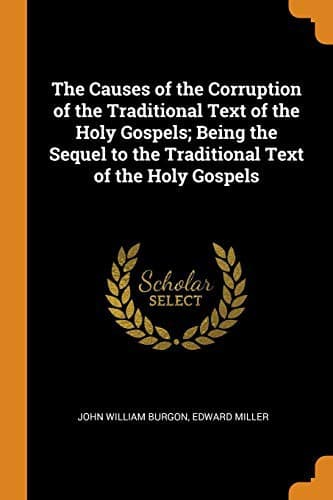
The Causes of the Corruption of the Traditional Text of the Holy Gospels: Being the Sequel to The Traditional Text of the Holy Gospels — John Shaqi
The Causes of the Corruption of the Traditional Text of the Holy Gospels: Being the Sequel to The Traditional Text of the Holy GospelsBurgon, John William
Religion
The Causes of the Corruption of the Traditional Text of the Holy Gospels: Being the Sequel to The Traditional Text of the Holy Gospels
Burgon, John William
Bible. Gospels -- Criticism, Textual
But it is high time to point out, that irregularities which fall under
these last heads are only tolerable within narrow limits, and always
require careful watching; for they may easily become excessive or even
betray an animus; and in either case they pass at once into quite a
different category. From cases of excusable oscitancy they degenerate,
either into instances of inexcusable licentiousness, or else into cases
of downright fraud.
6. Thus, if it be observed in the case of a Codex (_a_) that entire
sentences or significant clauses are habitually omitted:--(_b_) that
again and again in the course of the same page the phraseology of the
Evangelist has upon clear evidence been seriously tampered with: and
(_c_) that interpolations here and there occur which will not admit of
loyal interpretation:--we cannot but learn to regard with habitual
distrust the Codex in which all these notes are found combined. It is as
when a witness, whom we suspected of nothing worse than a bad memory or
a random tongue or a lively imagination, has been at last convicted of
deliberate suppression of parts of his evidence, misrepresentation of
facts,--in fact, deliberate falsehood.
7. But now suppose the case of a MS. in which words or clauses are
clearly omitted with design; where expressions are withheld which are
confessedly harsh or critically difficult,--whole sentences or parts of
them which have a known controversial bearing;--Suppose further that the
same MS. abounds in worthless paraphrase, and contains apocryphal
additions throughout:--What are we to think of our guide then? There can
be but one opinion on the subject. From habitually trusting, we shall
entertain inveterate distrust. We have ascertained his character. We
thought he was a faithful witness, but we now find from experience of
his transgressions that we have fallen into bad company. His witness may
be false no less than true: confidence is at an end.
Sec. 4.
Public-domain text, read in full here on John Shaqi.
Reviews
Reviews
No reviews yet
Be the first to share your thoughts on this work.
Join the Discussion
Join the discussion
Sign in to leave a comment or review.
Sign InorCreate an account