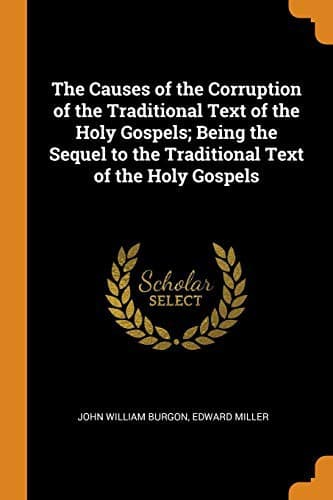
The Causes of the Corruption of the Traditional Text of the Holy Gospels: Being the Sequel to The Traditional Text of the Holy GospelsBurgon, John William
Religion
The Causes of the Corruption of the Traditional Text of the Holy Gospels: Being the Sequel to The Traditional Text of the Holy Gospels
Burgon, John William
Bible. Gospels -- Criticism, Textual
St. Mark viii. 26. After curing the blind man outside Bethsaida, our
Lord in that remarkable period of His career directed him, according to
the Traditional reading, ([Symbol: alpha]) neither to enter into that
place, [Greek: mede eis ten komen eiselthes], nor ([Symbol: beta]) to
tell what had happened to any inhabitant of Bethsaida ([Greek: mede
eipes tini en te kome]). Either some one who did not understand the
Greek, or some matter-of-fact and officious scholar, or both, thought or
maintained that [Greek: tini en te kome] must mean some one who was at
the moment actually in the place. So the second clause got to be omitted
from the text of B[Symbol: Aleph], who are followed only by one cursive
and a half (the first reading of 1 being afterwards corrected), and the
Bohairic version, and the Lewis MS. The Traditional reading is attested
by ACN[Symbol: Sigma] and thirteen other Uncials, all Cursives except
eight, of which six with [Symbol: Phi] read a consolidation of both
clauses, by several versions, and by Theophylact (i. 210) who is the
only Father that quotes the place. This evidence ought amply to ensure
the genuineness of this reading.
But what says Dr. Hort? 'Here [Symbol: alpha] is simple and vigorous,
and it is unique in the New Testament: the peculiar [Greek: Mede] has
the terse force of many sayings as given by St. Mark, but the softening
into [Greek: Me] by [Symbol: Aleph]* shews that it might trouble
scribes.' It is surely not necessary to controvert this. It may be said
however that [Symbol: alpha] is bald as well as simple, and that the
very difficulty in [Symbol: beta] makes it probable that that clause was
not invented. To take [Greek: tini en te kome] Hebraistically for
[Greek: tini ton en te kome], like the [Greek: tis en hymin] of St.
James v. 19[620], need not trouble scholars, I think. Otherwise they can
follow Meyer, according to Winer's Grammar (II. 511), and translate the
second [Greek: mede] _nor even_. At all events, this is a poor pillar to
support a great theory.
(3) St. Mark ix. 38. 'Master, we saw one casting out devils in Thy name,
([Symbol: beta]) who doth not follow us, and we forbad him ([Symbol:
alpha]) because he followeth not us.'
Here the authority for [Symbol: alpha] is [Symbol: Aleph]BCL[Symbol:
Delta], four Cursives, f, Bohairic, Peshitto, Ethiopic, and the Lewis
MS. For [Symbol: beta] there are D, two Cursives, all the Old Latin but
f and the Vulgate. For the Traditional Text, i.e. the whole passage,
A[Symbol: Phi][Symbol: Sigma]N + eleven Uncials, all the Cursives but
six, the Harkleian (yet obelizes [Symbol: alpha]) and Gothic versions,
Basil (ii. 252), Victor of Antioch (Cramer, Cat. i. 365), Theophylact
(i. 219): and Augustine quotes separately both omissions ([Symbol:
alpha] ix. 533, and [Symbol: beta] III. ii. 153). No other Fathers, so
far as I can find, quote the passage.
Public-domain text, read in full here on John Shaqi.
Reviews
Reviews
No reviews yet
Be the first to share your thoughts on this work.
Elsewhere in the archive
Join the Discussion
Join the discussion
Sign in to leave a comment or review.
Sign InorCreate an account