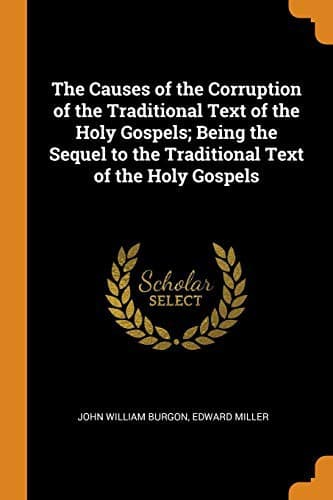
The Causes of the Corruption of the Traditional Text of the Holy Gospels: Being the Sequel to The Traditional Text of the Holy GospelsBurgon, John William
Religion
The Causes of the Corruption of the Traditional Text of the Holy Gospels: Being the Sequel to The Traditional Text of the Holy Gospels
Burgon, John William
Bible. Gospels -- Criticism, Textual
Now the second clause of the sentence, viz. the words [Greek: oude echo
ten psychen mou timian emauto], may on no account be surrendered. It is
indeed beyond the reach of suspicion, being found in Codd. A, D, E, H,
L, P, 13, 31,--in fact in every known copy of the Acts, except the
discordant [Symbol: Aleph]BC. The clause in question is further
witnessed to by the Vulgate[35],--by the Harkleian[36],--by
Basil[37],--by Chrysostom[38],--by Cyril[39],--by Euthalius[40],--and by
the interpolator of Ignatius[41]. What are we to think of our guides
(Tischendorf, Tregelles, Westcott and Hort, and the Revisers) who have
nevertheless surrendered the Traditional Text and presented us instead
with what Dr. Field,--who is indeed a Master in Israel,--describes as
the impossible [Greek: all' oudenos logou poioumai ten psychen timian
emauto][42]?
The words of the last-named eminent scholar on the reading just cited
are so valuable in themselves, and are observed to be so often in point,
that they shall find place here:--'Modern Critics,' he says, 'in
deference to the authority of the older MSS., and to certain critical
canons which prescribe that preference should be given to the shorter
and more difficult reading over the longer and easier one, have decided
that the T.R. in this passage is to be replaced by that which is
contained in those older MSS.
'In regard to the difficulty of this reading, that term seems hardly
applicable to the present case. A difficult reading is one which
presents something apparently incongruous in the sense, or anomalous in
the construction, which an ignorant or half-learned copyist would
endeavour, by the use of such critical faculty as he possessed, to
remove; but which a true critic is able, by probable explanation, and a
comparison of similar cases, to defend against all such fancied
improvements. In the reading before us, [Greek: all' oudenos logou
poioumai ten psychen timian emauto], it is the construction, and not the
sense, which is in question; and this is not simply difficult, but
impossible. There is really no way of getting over it; it baffles
novices and experts alike[43].' When will men believe that a reading
vouched for by only B[Symbol: Aleph]C is safe to be a fabrication[44]?
But at least when Copies and Fathers combine, as here they do, against
those three copies, what can justify critics in upholding a text which
carries on its face its own condemnation?
Sec. 3.
We now come to the inattention of those long-since-forgotten Ist or IInd
century scribes who, beguiled by the similarity of the letters [Greek:
EN] and [Greek: AN] (in the expression [Greek: ENANthropois eudokia],
St. Luke ii. 14), left out the preposition. An unintelligible clause was
the consequence, as has been explained above (p. 21): which some one
next sought to remedy by adding to [Greek: eudokia] the sign of the
genitive ([Greek: S]). Thus the Old Latin translations were made.
Public-domain text, read in full here on John Shaqi.
Reviews
Reviews
No reviews yet
Be the first to share your thoughts on this work.
Join the Discussion
Join the discussion
Sign in to leave a comment or review.
Sign InorCreate an account