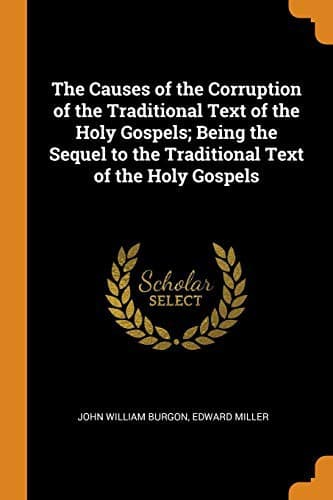
The Causes of the Corruption of the Traditional Text of the Holy Gospels: Being the Sequel to The Traditional Text of the Holy Gospels — John Shaqi
The Causes of the Corruption of the Traditional Text of the Holy Gospels: Being the Sequel to The Traditional Text of the Holy GospelsBurgon, John William
Religion
The Causes of the Corruption of the Traditional Text of the Holy Gospels: Being the Sequel to The Traditional Text of the Holy Gospels
Burgon, John William
Bible. Gospels -- Criticism, Textual
And yet it is perfectly certain that the words are genuine. Those
thirty-one letters probably formed three lines in the oldest copies of
all. Hence they are observed to exist in the Syriac (Peshitto, Harkleian
and Jerusalem), the Vulgate, some copies of the Old Latin, the Armenian,
and the Ethiopic, besides at least seventeen uncials (including
B[Symbol: Phi][Symbol: Sigma]), and the vast majority of the cursives.
So that there can be no question of the genuineness of the clause.
A somewhat graver instance of omission resulting from precisely the same
cause meets us a little further on in the same Gospel. The threefold
recurrence of [Greek: ton] in the expression [Greek: TON psichion TON
piptonTON] (St. Luke xvi. 21), has (naturally enough) resulted in the
dropping of the words [Greek: psichion ton] out of some copies.
Unhappily the sense is not destroyed by the omission. We are not
surprised therefore to discover that the words are wanting in--[Symbol:
Aleph]BL: or to find that [Symbol: Aleph]BL are supported here by copies
of the Old Latin, and (as usual) by the Egyptian versions, nor by
Clemens Alex.[50] and the author of the Dialogus[51]. Jerome, on the
other hand, condemns the Latin reading, and the Syriac Versions are
observed to approve of Jerome's verdict, as well as the Gothic. But what
settles the question is the fact that every known Greek MS., except
those three, witnesses against the omission: besides Ambrose[52],
Jerome[53], Eusebius[54] Alex., Gregory[55] Naz., Asterius[56],
Basil[57], Ephraim[58] Syr., Chrysostom[59], and Cyril[60] of
Alexandria. Perplexing it is notwithstanding to discover, and
distressing to have to record, that all the recent Editors of the
Gospels are more or less agreed in abolishing 'the crumbs which fell
from the rich man's table.'
[The foregoing instances afford specimens of the influence of accidental
causes upon the transmission from age to age of the Text of the Gospels.
Before the sense of the exact expressions of the Written Word was
impressed upon the mind of the Church,--when the Canon was not
definitely acknowledged, and the halo of antiquity had not yet gathered
round writings which had been recently composed,--severe accuracy was
not to be expected. Errors would be sure to arise, especially from
accident, and early ancestors would be certain to have a numerous
progeny; besides that evil would increase, and slight deviations would
give rise in the course of natural development to serious and perplexing
corruptions.
In the next chapter, other kinds of accidental causes will come under
consideration.]
FOOTNOTES:
[50] P. 232.
[51] _Ap._ Orig. i. 827.
[52] Ambrose i. 659, 1473, 1491:--places which shew how insecure would
be an inference drawn from i. 543 and 665.
[53] Hieron. v. 966; vi. 969.
[54] _Ap._ Mai ii. 516, 520.
[55] i. 370.
[56] P. 12.
[57] ii. 169.
[58] ii. 142.
[59] i. 715, 720; ii. 662 (_bis_) 764; vii. 779.
[60] v^{2}. 149 (luc. text, 524).
CHAPTER IV.
Public-domain text, read in full here on John Shaqi.
Reviews
Reviews
No reviews yet
Be the first to share your thoughts on this work.
Join the Discussion
Join the discussion
Sign in to leave a comment or review.
Sign InorCreate an account