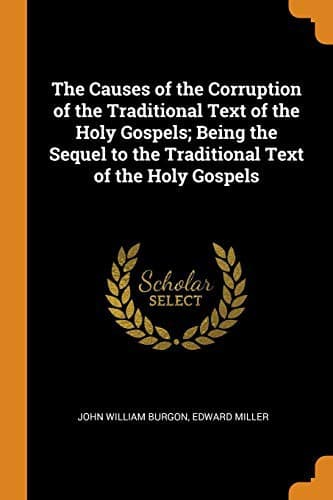
The Causes of the Corruption of the Traditional Text of the Holy Gospels: Being the Sequel to The Traditional Text of the Holy Gospels — John Shaqi
The Causes of the Corruption of the Traditional Text of the Holy Gospels: Being the Sequel to The Traditional Text of the Holy GospelsBurgon, John William
Religion
The Causes of the Corruption of the Traditional Text of the Holy Gospels: Being the Sequel to The Traditional Text of the Holy Gospels
Burgon, John William
Bible. Gospels -- Criticism, Textual
If hesitation to accept the foregoing verdict lingers in any quarter, it
ought to be dispelled by a glance at the context in [Symbol: Aleph]BL.
What else but the instinct of a trained understanding is it to survey
the neighbourhood of a place like the present? Accordingly, we discover
that in ver. 16, for [Greek: gemisai ten koilian autou apo], [Symbol:
Aleph]BDLR present us with [Greek: chortasthenai ek]: and in ver. 22,
the prodigal, on very nearly the same authority ([Symbol: Aleph]BDUX),
is made to say to his father,--[Greek: Poieson me hos hena ton misthion
sou]:
Which certainly he did not say[72]. Moreover, [Symbol: Aleph]BLX and the
Old Latin are for thrusting in [Greek: tachy] (D [Greek: tacheos]) after
[Greek: exenenkate]. Are not these one and all confessedly fabricated
readings? the infelicitous attempts of some well-meaning critic to
improve upon the inspired original?
From the fact that three words in St. John v. 44 were in the oldest MSS.
written thus,--[Greek: MONOUTHUOU] (i.e. [Greek: monou Theou ou]), the
middle word ([Greek: theou]) got omitted from some very early copies;
whereby the sentence is made to run thus in English,--'And seek not the
honour which cometh from the only One.' It is so that Origen[73],
Eusebius[74], Didymus[75], besides the two best copies of the Old Latin,
exhibit the place. As to Greek MSS., the error survives only in B at the
present day, the preserver of an Alexandrian error.
Sec. 3.
St. Luke explains (Acts xxvii. 14) that it was the 'typhonic wind called
Euroclydon' which caused the ship in which St. Paul and he sailed past
Crete to incur the 'harm and loss' so graphically described in the last
chapter but one of the Acts. That wind is mentioned nowhere but in this
one place. Its name however is sufficiently intelligible; being
compounded of [Greek: Euros], the 'south-east wind,' and [Greek:
klydon], 'a tempest:' a compound which happily survives intact in the
Peshitto version. The Syriac translator, not knowing what the word
meant, copied what he saw,--'the blast' (he says) 'of the tempest[76],
which [blast] is called Tophonikos Eurokl[=i]don.' Not so the licentious
scribes of the West. They insisted on extracting out of the actual
'Euroclydon,' the imaginary name 'Euro-aquilo,' which accordingly stands
to this day in the Vulgate. (Not that Jerome himself so read the name of
the wind, or he would hardly have explained '_Eurielion_' or
'_Euriclion_' to mean 'commiscens, sive deorsum ducens[77].') Of this
feat of theirs, Codexes [Symbol: Aleph] and A (in which [Greek:
EUROKLUDON] has been perverted into [Greek: EURAKULON]) are at this day
_the sole surviving Greek witnesses_. Well may the evidence for
'Euro-aquilo' be scanty! The fabricated word collapses the instant it is
examined. Nautical men point out that it is 'inconsistent in its
construction with the principles on which the names of the intermediate
or compound winds are framed:'--
Public-domain text, read in full here on John Shaqi.
Reviews
Reviews
No reviews yet
Be the first to share your thoughts on this work.
Join the Discussion
Join the discussion
Sign in to leave a comment or review.
Sign InorCreate an account