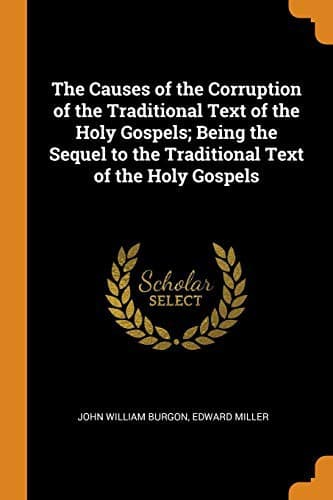
The Causes of the Corruption of the Traditional Text of the Holy Gospels: Being the Sequel to The Traditional Text of the Holy GospelsBurgon, John William
Religion
The Causes of the Corruption of the Traditional Text of the Holy Gospels: Being the Sequel to The Traditional Text of the Holy Gospels
Burgon, John William
Bible. Gospels -- Criticism, Textual
The strength of the position of the Traditional Text lies in its being
logically deducible and to be deduced from all the varied evidence which
the case supplies, when it has been sifted, proved, passed, weighed,
compared, compounded, and contrasted with dissentient testimony. The
contrast is indeed great in almost all instances upon which controversy
has gathered. On one side the vast mass of authorities is assembled: on
the other stands a small group. Not inconsiderable is the advantage
possessed by that group, as regards numerous students who do not look
beneath the surface, in the general witness in their favour borne by the
two oldest MSS. of the Gospels in existence. That advantage however
shrinks into nothing under the light of rigid examination. The claim for
the Text in them made at the Semiarian period was rejected when
Semiarianism in all its phases fell into permanent disfavour. And the
argument advanced by Dr. Hort that the Traditional Text was a new Text
formed by successive recensions has been refuted upon examination of the
verdict of the Fathers in the first four centuries, and of the early
Syriac and Latin Versions. Besides all this, those two manuscripts have
been traced to a local source in the library of Caesarea. And on the
other hand a Catholic origin of the Traditional Text found on later
vellum manuscripts has been discovered in the manuscripts of papyrus
which existed all over the Roman Empire, unless it was in Asia, and were
to some degree in use even as late as the ninth century; before and
during the employment of vellum in the Caesarean school, and in
localities where it was used in imitation of the mode of writing books
which was brought well-nigh to perfection in that city.
Public-domain text, read in full here on John Shaqi.
Reviews
Reviews
No reviews yet
Be the first to share your thoughts on this work.
Join the Discussion
Join the discussion
Sign in to leave a comment or review.
Sign InorCreate an account