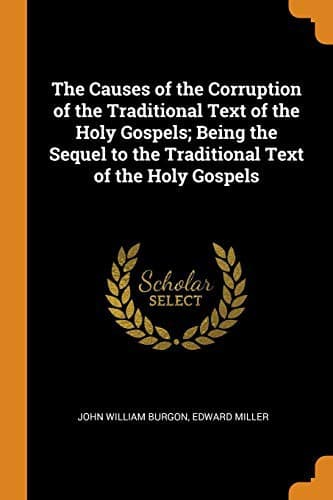
The Causes of the Corruption of the Traditional Text of the Holy Gospels: Being the Sequel to The Traditional Text of the Holy Gospels — John Shaqi
The Causes of the Corruption of the Traditional Text of the Holy Gospels: Being the Sequel to The Traditional Text of the Holy GospelsBurgon, John William
Religion
The Causes of the Corruption of the Traditional Text of the Holy Gospels: Being the Sequel to The Traditional Text of the Holy Gospels
Burgon, John William
Bible. Gospels -- Criticism, Textual
Thus it appears that errors crept in at the very first commencement of
the life of the Church. This is a matter so interesting and so important
in the history of corruption, that I must venture to place it again
before our readers.
Why was Galilee chosen before Judea and Jerusalem as the chief scene of
our Lord's Life and Ministry, at least as regards the time spent there?
Partly, no doubt, because the Galileans were more likely than the other
inhabitants of Palestine to receive Him. But there was as I venture to
think also another very special reason.
'Galilee of the nations' or 'the Gentiles,' not only had a mixed
population[4] and a provincial dialect[5], but lay contiguous to the
rest of Palestine on the one side, and on others to two districts in
which Greek was largely spoken, namely, Decapolis and the parts of Tyre
and Sidon, and also to the large country of Syria. Our Lord laid
foundations for a natural growth in these parts of the Christian
religion after His death almost independent as it seems of the centre of
the Church at Jerusalem. Hence His crossings of the lake, His miracles
on the other side, His retirement in that little understood episode in
His life when He shrank from persecution[6], and remained secretly in
the parts of Tyre and Sidon, about the coasts of Decapolis, on the
shores of the lake, and in the towns of Caesarea Philippi, where the
traces of His footsteps are even now indicated by tradition[7]. His
success amongst these outlying populations is proved by the unique
assemblage of the crowds of 5000 and 4000 men besides women and
children. What wonder then if the Church sprang up at Damascus, and
suddenly as if without notice displayed such strength as to draw
persecution upon it! In the same way the Words of life appear to have
passed throughout Syria over congenial soil, and Antioch became the
haven whence the first great missionaries went out for the conversion of
the world. Such were not only St. Paul, St. Peter, and St. Barnabas, but
also as is not unreasonable to infer many of that assemblage of
Christians at Rome whom St. Paul enumerates to our surprise in the last
chapter of his Epistle to the Romans. Many no doubt were friends whom
the Apostle of the Gentiles had met in Greece and elsewhere: but there
are reasons to shew that some at least of them, such as Andronicus and
Junias or Junia[8] and Herodion, may probably have passed along the
stream of commerce that flowed between Antioch and Rome[9], and that
this interconnexion between the queen city of the empire and the
emporium of the East may in great measure account for the number of
names well known to the apostle, and for the then flourishing condition
of the Church which they adorned.
Public-domain text, read in full here on John Shaqi.
Reviews
Reviews
No reviews yet
Be the first to share your thoughts on this work.
Join the Discussion
Join the discussion
Sign in to leave a comment or review.
Sign InorCreate an account